The 15-Minute Daily English Routine for Kids That Actually Works
Picture a parent who sits down with a 5-year-old for what's meant to be a solid hour of English practice. Flashcards are spread across the table. A worksheet is printed. A YouTube playlist is queued up.
By minute twelve, the child is under the table.
By minute twenty, there are tears. The parent is frustrated and the flashcards are on the floor. Another "English time" has ended badly, and it's easy to start wondering whether the child just isn't ready for a second language.
Usually the better move is the smaller one. Stop doing an hour. Do fifteen minutes.
A child who fights the hour is far more likely to come to a short session willingly, with nothing forced. Fifteen focused minutes feels more like play than school. There's room to remember words and try out a sentence, and nobody ends up crying.
There's nothing magic about it. Short, frequent practice suits the way young brains pick up language. Research shows that starting early matters, and a short daily routine is one of the best ways to use your child's natural learning window.
Why 15 minutes beats 1 hour
If you've been trying to teach your child English at home with long, structured sessions, you're working against the way young brains process language. Here's why shorter wins.
Start with memory. Research on spaced repetition and memory consolidation shows that the brain keeps new vocabulary far better after short daily practice than after occasional long sessions. Distributed practice is one of the most reliable findings in memory science (Cepeda et al., 2006): the same total study time gives stronger retention when it's spread across short sessions instead of crammed into a few long ones.
Then there's attention span. Young children can only stay on a structured task for a short stretch, and that stretch grows slowly with age: a 7-year-old usually lasts longer than a 4-year-old, but neither is built for an hour. Asking a young child to do an hour of English is like asking an adult to run a marathon without training. The only thing it builds is dread.
Consistency also beats intensity. Fifteen minutes a day, seven days a week, gives you 105 minutes of practice. That's nearly two hours, spread across the week so each session builds on yesterday's memory before it fades. Long sessions are much harder to keep up. They get skipped when the week gets busy, and for many families they stop altogether.
You also tend to see results early. With a short daily routine, many parents soon hear their child using new words without being prompted. That early progress feeds itself: the child feels successful, so they want to do it again.
The 3-part routine: your daily 15 minutes
The structure is the same three parts every day, so there's nothing to plan.
Part 1: Warm-up conversation (5 minutes)
No screens and no materials, only you and your child talking.
Pick one simple question or prompt and talk it through together in English. The aim is for your child to get comfortable hearing and making English sounds while nothing is riding on it.
Sample warm-up prompts:
- "What did you eat for breakfast? Was it yummy?"
- "Look outside. What color is the sky right now?"
- "If you could be any animal today, which one?"
- "Can you count the blue things in this room?"
- "What is your favorite word? Why do you like it?"
Keep it conversational. If your child answers in their first language, gently echo it back in English. If they don't know a word, give it to them cheerfully and move on. It's a warm-up, and nobody is keeping score.
Part 2: App lesson (5-7 minutes)
This is the main learning block. One lesson in Small Universe takes a few minutes and gives your child structured vocabulary practice in one of 17 game types, from matching and memory flip to word building and sentence scramble.
An app lesson fits the middle slot well because you don't have to plan what comes next. Games are matched to your child's age, and words your child misses in Matching come back for another try. The game type changes from lesson to lesson (from age 6, a spinning Game Wheel picks it), which makes Tuesday feel different from Monday even when the vocabulary is the same. Your child can see themselves moving through the planets (Earth to Mars to Jupiter to Saturn), and a lesson finished with full stars comes back for a gold-star review 72 hours later, so the words get a second look after a gap.
One lesson with one game covers the structured part. For more ideas on game-based learning, see our roundup of the best English games for kids.
Try a free Small Universe lesson and see how it fits into your routine.
Part 3: Quick review (3 minutes)
After the app lesson, spend three minutes going back over what your child just practiced. This is the point where short-term memory starts turning into long-term memory.
Run through these, about 60 seconds each:
- Recall. "Can you remember three words from your lesson?" No peeking. If they get stuck, give a hint ("It was an animal that says 'moo'").
- Silly sentence. Take one word from the lesson and make the silliest sentence you can. "The ELEPHANT is eating my SPAGHETTI!" Laughter helps memory.
- Point-and-name. Walk around the room and point at objects. "What is this in English?" Mix in easy wins with one or two new words.
That's the whole routine: a conversation, a structured lesson and a quick review, fifteen minutes in all.
Age-specific tweaks
The three parts stay the same at every age. What changes is how you run each one, depending on where your child is developmentally.
Ages 3-4: Keep it physical and playful
At this age, children learn with their bodies as much as their heads. Sitting still for fifteen minutes isn't realistic, and they don't need to.
For the warm-up, use real objects instead of abstract questions. Hold up a banana: "What is this? What color is it? Is it big or small?" Let them hold and play with whatever you're talking about. Sing a short English song together. "Head, Shoulders, Knees and Toes" is a classic for a reason.
For the app lesson, stick to five minutes maximum. Small Universe's matching and bubble pop games work well at this age because they need simple taps and give immediate visual rewards. Sit with your child and narrate what's happening on screen. "Oh, you found the CAT! Great job!"
For the review, make it a movement game. "Can you jump to something RED?" "Can you hop like a FROG?" A jump or a hop tells you they understood, even before they can say the English word.
Earth, the first planet in Small Universe, covers Pre-A1 to A1. It introduces basic words a small set at a time, which is about as much as this age group can take in at once. For more app recommendations at this stage, see our guide to the best English apps for 3-4 year olds.
Ages 5-7: Add structure and choice
Children in this range are getting ready to read and starting to want some independence. They like feeling capable and in charge. (For app recommendations at this stage, see our guide to the best English apps for 5-7 year olds.)
For the warm-up, introduce "Would you rather" questions. "Would you rather fly like a BIRD or swim like a FISH?" Answering takes more thought, so the English answers get longer. Try a "Word of the Day" that you both use as many times as possible before bedtime.
For the app lesson, let your child make the choice when possible, such as which finished lesson to replay. The full seven minutes works well here. This is the age when story mode starts to click, and from age 6 word builder and sentence scramble join the mix. Step back and let them play independently, but stay nearby to celebrate wins.
For the review, try the "Teach Me" reversal: your child teaches you the words they just learned. Explaining something to someone else is one of the best memory aids at any age. Ham it up. Pretend to get words wrong so they can correct you.
Ages 8-10: Build toward independence
Older children can handle more independence, and they get something out of seeing how their own learning works.
For the warm-up, have a real mini-conversation in English. Talk about their day, a book they're reading, or something that happened at school. Try a "question chain" where you take turns asking each other questions in English.
For the app lesson, games like conversation simulation, picture dictation, and chain reaction stretch them with harder language. They can follow their own progress through Jupiter and on to Saturn, the grammar planet, where the level climbs to A2 to B1.
For the review, start a shared "English journal." After each session, your child writes one sentence about what they learned. It can be as simple as "Today I learned the word TELESCOPE." After a few weeks, the journal is a record they can flip through, and watching it grow keeps them going.
Your weekly schedule: 7 days of variety
A daily routine doesn't have to be the same every day. Here's a sample week that keeps the three-part structure and changes the details each day.
| Day | Warm-Up Theme | App Focus | Review Activity |
|---|---|---|---|
| Monday | "Weekend recap": what did you do? | New lesson (new vocabulary) | Recall Game: name 3 new words |
| Tuesday | "Color hunt": find colors around the house | Review previous lesson | Silly Sentence with yesterday's words |
| Wednesday | "Would you rather" questions | New lesson (new vocabulary) | Teach Me: child teaches parent |
| Thursday | "Counting game": count objects in English | Practice a challenging game type | Point-and-Name walk around the room |
| Friday | "Story starter": make up a story together | New lesson (new vocabulary) | Draw a picture of one new word |
| Saturday | "Song time": sing an English song | Free choice: child picks any open lesson | Act out a word (charades style) |
| Sunday | "Week review": what words do you remember? | Replay a favorite lesson | Write in English journal (ages 5+) |
That works out to three new lessons a week, two review sessions, and two free-choice days. New words get time to settle, and your child gets to run the weekend sessions.
You can print this schedule and stick it on the fridge. Once the routine is up where everyone can see it, it becomes part of the family's day instead of something you have to decide on every morning.
When your child says "no"
It will happen. Even with a solid 15-minute routine, some days your child will push back. Children do that, and it doesn't mean the routine has failed.
These are the objections you'll hear most, and how to handle them.
"I don't want to do English today."
Acknowledge the feeling, then shrink the ask. "That's okay. Let's just do the warm-up part. Two minutes. If you want to stop after that, we stop." More often than not, once they start, they keep going. The hardest part is always the first thirty seconds.
Don't force it or bribe them with unrelated rewards, and don't let it turn into a power struggle. Once English becomes a battleground, you've lost months of progress.
"This is boring."
This usually means the content is too easy or too repetitive. In Small Universe, try replaying a lesson your child liked, or move on to the next one. The game changes from lesson to lesson across 17 formats, so if matching feels stale, the next lesson may bring word hunt or alien translator, which feel like a different game entirely. For the warm-up, let your child pick the topic.
Don't push through with the same material. Boredom is telling you something, so pay attention to it.
"I'm not good at English."
This is the most important one to get right. Show them their progress. Scroll back through completed lessons. Look at the English journal. Remind them of words they know now that they didn't know a month ago. Say: "You're not bad at English. You're learning English. Those are two very different things."
Never compare them to siblings, classmates or any other child.
The nuclear option: skip the day
Sometimes the right move is to skip. If your child is sick, exhausted, or having a really bad day, let it go. A single missed day doesn't break a habit. Forcing a miserable session on a bad day can. Say "We'll do our English adventure tomorrow" and move on without guilt.
The streak will survive, and your relationship with your child matters more than any streak anyway.
Making it stick: habit stacking
In practice, the routine is more likely to fall apart because of you than because of your child. Life gets busy, the evenings fill up and you forget.
The fix is habit stacking, a technique from behavioral psychology where you attach a new habit to one you already have. Instead of remembering to "do English at some point today," you anchor it to something that already happens automatically.
A few stacks that work well: do English right after breakfast, before screen time ("First we do our English adventure, then you can watch your show"). Or do it after bath and before the bedtime story. That wind-down time is good for language retention, because the brain consolidates memories during sleep. For school-age kids, after the snack and before homework is another natural slot.
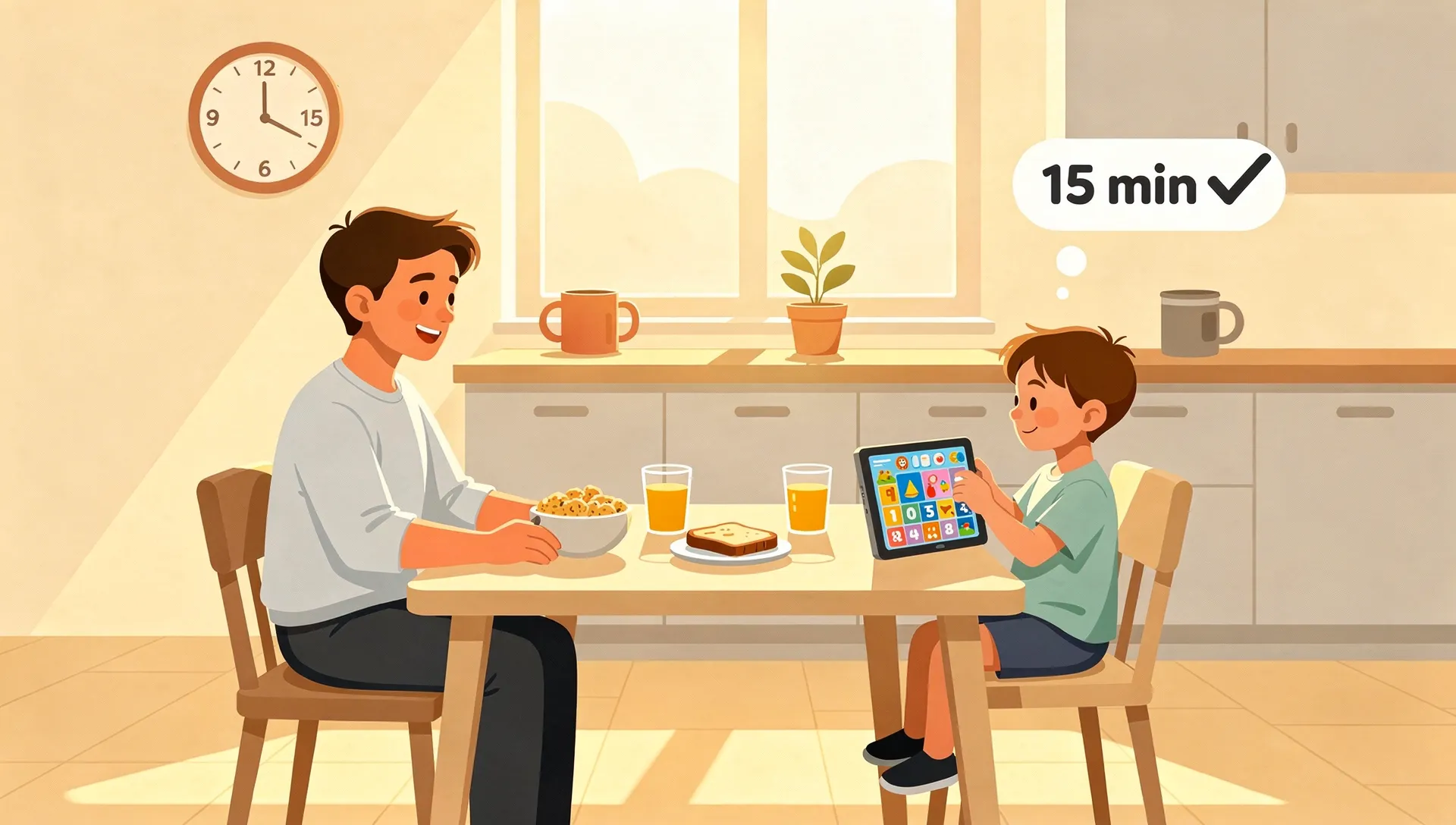
For the first two weeks, a few habits help. Keep the same time and the same place every day. A consistent setting helps the brain shift into "English mode" on its own, and after a while the kitchen table at 7:15 AM is a cue by itself. Set a phone alarm, not to time the session but to remind you to start it, and give it a name your child will enjoy hearing. And keep the streak where your child can see it. A simple wall calendar with a sticker for each completed day works better than any app notification. After seven stickers in a row, the row of stickers starts doing the motivating for you.
The long view
This is what fifteen minutes a day adds up to.
After one week, your child has met the words from a few new lessons and may be starting to use some of them on their own.
After one month, at about three new lessons a week, they've done roughly a dozen lessons and are working toward their first 100 essential words. The routine feels automatic. You're no longer convincing them to start.
After three months, they've usually left Earth behind, and many children are starting to form short sentences, mixing English words into everyday conversation without thinking about it.
After one year, three new lessons a week is enough to work through all 102 lessons (about 950 words), with time left over to replay favorites. Fifteen minutes a day also adds up to roughly 90 hours, which is about the guided learning time Cambridge English estimates for reaching CEFR A1. Children move at different speeds, and younger ones often take longer.
All from fifteen minutes a day.
You don't need textbooks or a tutor, and nobody has to end up in tears. It takes a short daily routine that fits how your child's brain works.
There's no reason to wait for a new week. Start with the next breakfast.
Play Small Universe in your browser and build your 15-minute routine around your first lesson.
Small Universe is a space-themed English learning app for children from about age 3, adult beginners and families. It has 17 game types and 7 planets, and its games are matched to your child's age, so it can be the structured part of your family's daily English routine. Learn more at smalluni.com.
Sources
This guide draws on the following research and reference works. It is written by Paul B.
- Cepeda, N. J., Pashler, H., Vul, E., Wixted, J. T., & Rohrer, D. (2006). Distributed practice in verbal recall tasks: A review and quantitative synthesis. Psychological Bulletin, 132(3), 354-380.
- Ebbinghaus, H. (1885/1913). Memory: A Contribution to Experimental Psychology. Teachers College, Columbia University.
- Krashen, S. D. (1982). Principles and Practice in Second Language Acquisition. Pergamon Press.
- Nation, I. S. P. (2001). Learning Vocabulary in Another Language. Cambridge University Press.
Try Small Universe free
17 game types and 7 planets, with no ads. Your child learns English by exploring space.
Play free, no account needed