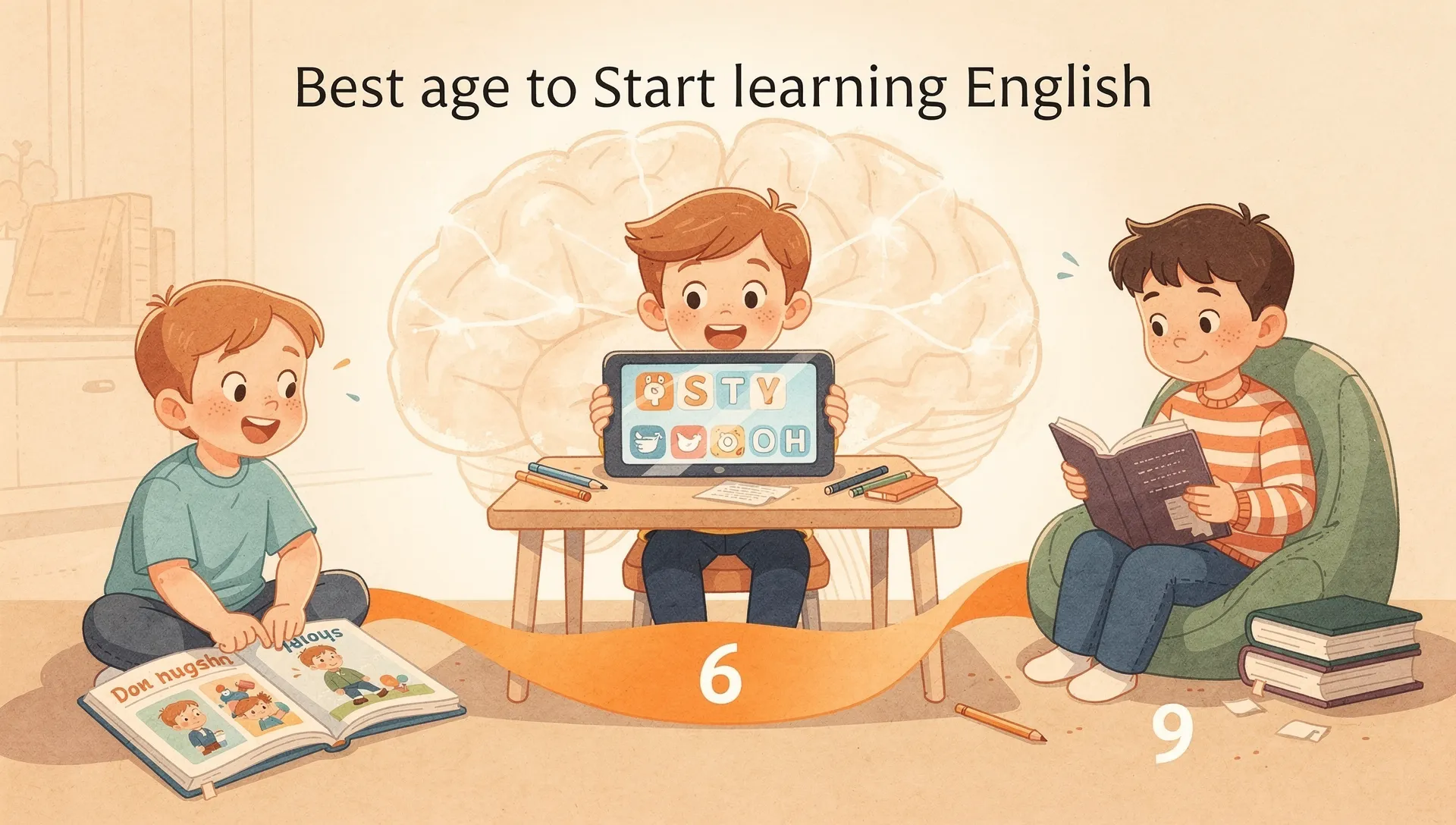
When Should My Child Start Learning English? What Brain Science Actually Says
What is the best age for kids to start learning English, and what if waiting is the biggest mistake you could make?
Maria sat at the kitchen table in Madrid, scrolling through parenting forums at midnight. Her daughter Sofia had just turned three. Maria's English was okay – good enough for work emails, shaky during conference calls. She wanted something different for Sofia. Something easier.
But every thread she read said something different. "Wait until they're in school." "Start at birth or forget it." "You'll confuse them." "It's never too early." "It's never too late."
She closed her laptop, more anxious than when she started.
If you've ever felt like Maria, this article is for you. Not opinions. Not guesses. What the actual science says about when children learn languages best – and what that means for your family right now.
What the research actually says
The MIT and Harvard study that changed everything
In 2018, researchers from MIT and Harvard published one of the largest language-learning studies ever conducted. They analyzed data from nearly 670,000 people to answer a deceptively simple question: is there a best age to start learning a second language?
Their conclusion was clear. To achieve native-like proficiency in a second language, a child should ideally begin before age 10. After that, the ability to reach native-level grammar doesn't disappear overnight, but it declines steadily. By puberty, the sharpest drop occurs (Hartshorne, Tenenbaum, & Pinker, 2018).
This wasn't a small lab experiment. It was the largest dataset ever assembled on this question.
The critical period: your child's language superpower
Neuroscientists call the years from birth through early adolescence the "critical period" for language acquisition. During this window, a child's brain is uniquely wired to absorb the sounds, patterns, and structures of language – any language – with surprising efficiency.
Here's why young children have an advantage that no amount of adult studying can replicate:
They hear sounds adults literally cannot. Before around age 8-10, children's brains haven't yet learned to filter out sounds that don't exist in their native language. A Japanese child can still hear the difference between "r" and "l" at age 4. By adulthood, that distinction becomes nearly invisible to them. This is why children who start early can achieve genuinely native pronunciation (Kuhl, 2004).
They don't fight their first language. Adults learning English constantly translate back and forth from their mother tongue. Children don't do this. They build a second language system alongside their first, rather than on top of it. Less interference means fewer fossilized errors.
They tolerate ambiguity. A three-year-old doesn't panic when they hear a sentence they don't fully understand. They pick up context, grab the words they know, and keep going. Adults, by contrast, often freeze when comprehension isn't complete. That tolerance for ambiguity is, paradoxically, a learning superpower.
The peak window: ages 0 to 7
Within the critical period, there's an even sharper peak. Research consistently shows that second-language acquisition skills are strongest between birth and roughly age 6 or 7 (Lenneberg, 1967; Johnson & Newport, 1989).
This doesn't mean a seven-year-old is "too late." Far from it. But if your child is currently in this window, you're sitting on a biological goldmine.
The brain will never again be this hungry for language.
The age-by-age guide: what to actually expect
One of the biggest sources of parental anxiety is not knowing what "normal" looks like. Here's a realistic, research-informed breakdown of what English learning looks like at different ages.
Ages 3-4: the sound sponge
Your child is in the peak of phonological acquisition. Their auditory cortex is mapping every sound it hears, building the inventory of phonemes they'll use for life. This is the age when accent-free pronunciation is most achievable.
At this age, "learning English" doesn't look like studying. It looks like playing. For practical tips, see our guide on how to teach English to preschoolers. If you're looking for tools that match this stage, see our guide to the best English apps for 3-4 year olds. A three-year-old absorbs individual words (colors, animals, body parts, food) through repetition, songs, and visual association. They won't produce sentences. They might mix languages freely. This is completely normal and not a sign of confusion.
What to expect: recognition of 50-100 English words after a few months of regular exposure. Single-word or two-word responses. A lot of listening. An excellent accent.
CEFR alignment: Pre-A1 (total beginner). At this stage, the focus is entirely on vocabulary: nouns, basic verbs, concrete objects. No grammar instruction needed or appropriate.
Think of it this way: your child is building the foundation of a house. You can't see the walls yet, but every word they absorb is a brick that will hold everything up later.
Ages 5-7: the pattern finder
Between five and seven, children begin recognizing patterns instinctively. They start to internalize grammar rules without being taught them explicitly. They'll say "I goed to the park," which is actually a sign of sophisticated learning: they've extracted the past-tense rule and applied it (just to an irregular verb).
Children in this range can handle simple sentences, short stories, and interactive games that involve matching, sorting, and building. We've reviewed the best English apps for 5-7 year olds if you're looking for options at this stage. They begin reading in their first language, and that skill transfers to English. They love narrative, stories with characters, problems, and resolutions.
What to expect: basic conversational phrases. Simple present tense ("I like cats"). Questions ("What is this?"). Vocabulary of 300-500 words with regular practice. Growing confidence with pronunciation.
CEFR alignment: A1 (breakthrough). This is where basic questions, simple present tense, and connected vocabulary themes become appropriate. The transition from pure vocabulary to light grammar happens naturally.
Let me tell you about Kenji. His parents in Tokyo started him on English games at age 5, just 10 minutes a day. By age 7, Kenji was understanding simple English cartoons without subtitles. His parents hadn't drilled grammar. They hadn't hired a tutor. They'd given him consistent, playful exposure at the right level – and his brain did the rest.
Ages 8-10: the conscious learner
By eight, children are developing metacognitive abilities; they can think about their own thinking. This means they can handle more explicit learning strategies: comparing grammar rules, noticing patterns between languages, and self-correcting. They're still well within the critical period, but the unconscious absorption is gradually giving way to more deliberate learning.
Children in this range can engage with more complex game types: sentence building, word scrambles, conversation simulations, dictation exercises. They can handle past tense, descriptions, and "can/have" constructions. They're also old enough to feel self-conscious, which means the learning environment matters more than ever. Low-pressure, game-based contexts outperform classroom drilling at this age.
What to expect: conversational ability in familiar topics. Vocabulary of 500-1,000 words with consistent practice. Ability to describe daily routines, express preferences, and tell simple stories. Some accent influence from the first language, but still highly malleable.
CEFR alignment: A2 (waystage). Past simple, descriptions, and functional communication become achievable targets. With strong input, some children in this range push into early B1 territory.
The "it's not too late" truth
If you're reading this and your child is already 8, or 9, or 10, take a breath. The research is clear that earlier is better, but it's equally clear that "better" and "only" are not the same word.
The MIT/Harvard study found that the ability to learn grammar continues at a high level until roughly age 17-18, though the ceiling for native-like attainment drops after 10. What this means in practice: a child who starts at 8 will likely become highly proficient. They may not pass for a native speaker in a linguistics lab test. In every real-world situation that matters (school, travel, work, friendships) they'll be fluent.
Patricia Kuhl's research at the University of Washington adds an important nuance: while the phonological window narrows earliest (making accent-free acquisition harder after 8-10), grammatical and vocabulary acquisition remain strong well into adolescence.
The worst age to start is "never." The second-worst is "next year."
Every month of delay is a month of that critical period spent absorbing zero English input. The question isn't whether your child can still learn. Of course they can. The question is whether you want to spend that biological window or let it close unused.
Bilingual vs. monolingual families: different paths, same destination
If you already speak English at home
You have a massive advantage: natural input. Your child hears English in context – at dinner, during bedtime stories, in arguments about who ate the last cookie. This contextual, emotional, real-world input is the gold standard for language acquisition.
Your challenge is different: making sure the other language gets enough exposure. In English-dominant countries, minority languages need deliberate support. But for English itself, your child is already swimming in it.
Where structured learning helps: filling vocabulary gaps, introducing reading and writing skills, and providing the kind of systematic progression that organic conversation sometimes misses. A child might hear "beautiful" every day but never encounter "gorgeous," "stunning," or "hideous" without structured vocabulary expansion.
If English is a foreign language in your home
This is the situation most families worldwide are in. You might speak Turkish, Mandarin, Portuguese, Arabic, or Korean at home. English exists on screens, in songs, maybe in school – but not at the dinner table.
Here's the good news: you don't need to speak English to your child for them to learn it. What you need is consistent, comprehensible, age-appropriate input. Research shows that even 15-20 minutes of daily exposure to well-structured English input produces measurable results in children under 10 (Unsworth et al., 2014).
The key word is comprehensible. Which brings us to the most important learning theory most parents have never heard of.
Krashen's secret: why "just right" input changes everything
In the 1980s, linguist Stephen Krashen proposed something that sounded almost too simple to be true. He called it the Input Hypothesis, and decades of research have largely confirmed it.
In plain language: children acquire language when they understand messages that are just slightly above their current level.
Krashen called this "i+1" – where "i" is what the child already knows, and "+1" is the next small step beyond that. Not two steps. Not five. One.
Think about how you'd teach a child to swim. You wouldn't throw them into the deep end (too far beyond their level – they'd panic). You wouldn't keep them on dry land forever (no input at all). You'd put them in the shallow end, where they can touch the bottom but the water is real. Then, gradually, you'd move to slightly deeper water.
Language works the same way.
When a child who knows 50 English words plays a game that uses 45 familiar words and introduces 5 new ones – surrounded by pictures, sounds, and context clues – acquisition happens almost automatically. The brain fills in the gaps. The new words stick because they're anchored to comprehension.
When that same child is dropped into a lesson with 50 unfamiliar words and no context, nothing sticks. The input isn't comprehensible. It's just noise.
This is why generic YouTube videos are unreliable language teachers. They're not calibrated to your child's level. A video might be perfect i+1 for one child and incomprehensible noise for another.
Vygotsky's zone: the scaffolding principle
Russian psychologist Lev Vygotsky described something similar from a different angle. He identified a "Zone of Proximal Development" – the space between what a child can do alone and what they can do with support. Learning happens fastest in this zone.
In practical terms, this means the best English learning tools do three things:
- Assess where the child is right now (not where their age group "should" be)
- Present challenges just beyond their current ability
- Provide enough scaffolding (pictures, audio, context, hints) that success is achievable
When these three conditions are met, children don't just learn. They want to learn. The difficulty feels like a game, not a test.
What does bad early English learning look like?
Not all early exposure is equal. Some approaches can actually backfire. Here's what to avoid.
Drilling and memorization. Flashcard apps that show a word, demand a translation, and move on. This is how adults study, and it works poorly even for adults. For a four-year-old, it's actively counterproductive. It associates English with stress rather than play.
Correction-heavy environments. When a child says "I have three cat," the worst response is "No, it's CATS. Say it again." The best response? "Oh, you have three cats? That's a lot of cats!" You've modeled the correct form without creating anxiety. Krashen called this the "Affective Filter": when stress goes up, acquisition goes down.
Age-inappropriate content. A three-year-old doesn't need grammar explanations. An eight-year-old doesn't need baby songs. Developmental psychologist Jean Piaget mapped how children's cognitive abilities evolve in stages, from concrete sensory thinking in early childhood to increasingly abstract reasoning by age 10+. Content that ignores these stages will either bore or overwhelm.
Inconsistency. Twenty minutes three times a week beats two hours once a week. The brain consolidates language during sleep, so regular short sessions with rest in between dramatically outperform marathon study sessions (Walker, 2017).
How to start today (in 2 minutes)
Here's what the research points to, stripped of all complexity:
- If your child is between 3 and 10, they are in the critical period right now.
- They need comprehensible input at their level – not above it, not below it.
- They need it regularly – daily is ideal, even if it's just 10-15 minutes.
- It should feel like play, not like school.
- Starting today is better than starting tomorrow.
That's exactly why we built Small Universe.
Small Universe is an English learning app for children ages 3 to 10. It maps directly to the science in this article, and that's not a coincidence. It was built on this science.
Here's how it works:
Your child explores seven planets – Earth, Mars, Neptune, Jupiter, Uranus, Pluto, and Saturn – each representing a CEFR proficiency level from Pre-A1 through B1. Earth is where three-year-olds start, with concrete vocabulary: colors, animals, food, body parts. By Saturn, children are handling conditionals, comparisons, and continuous tenses.
Each lesson uses a Game Wheel that spins to select from 17 different game types – matching, bubble pop, memory flip, word building, story mode, conversation simulation, and more. Games are age-gated, so a three-year-old sees tap-and-match games while an eight-year-old gets sentence scrambles and dictation challenges.
This is Krashen's i+1 in action. Every lesson mixes 60% familiar words, 30% recently learned words, and 10% new vocabulary. The child is always working in their Zone of Proximal Development, challenged enough to grow, supported enough to succeed.
There are no flashcard drills. No red X marks. No grammar lectures. Just a small alien companion who explores planets with your child, evolving and growing as they learn.
It takes about 90 seconds to set up a profile: enter your child's name, pick their age, choose an avatar. The app calibrates everything from there.
Start your child's first planet – free
The story of two starts
Let me close with two families.
Yuki's parents in Osaka started her on Small Universe at age 4. She began on Earth, tapping animals and matching colors. She thought she was playing a space game. She was – she just happened to be absorbing 8-10 new English words per session along the way. By 5, she was on Mars, stringing together simple sentences without ever being told what a "sentence" was.
David's parents in Sao Paulo started him at age 9. They worried it was too late. David began on Earth too, but moved through it quickly – his older brain could handle faster progression. Within weeks he was on Mars, then Jupiter. He didn't get the accent-free pronunciation that Yuki got. But he got something Yuki didn't: the metacognitive ability to notice patterns, compare English to Portuguese, and self-correct. By the time he reached Saturn, he was reading simple English books for fun.
Two different ages. Two different paths. Both of them work.
But both of them required the same thing: a parent who decided that today was the day to start.
Key takeaways
- The critical period for language learning runs from birth through early adolescence, with the sharpest abilities between ages 0 and 7.
- MIT/Harvard research confirms: starting before age 10 gives children the best chance at native-like proficiency.
- Children hear sounds adults cannot, tolerate ambiguity better, and build second languages alongside (not on top of) their first.
- It's not too late for children aged 8-10. They're still in the critical period and can achieve high proficiency.
- Krashen's Input Hypothesis: children acquire language through comprehensible input at i+1, just one step above their current level.
- Consistency beats intensity: 10-15 minutes daily outperforms hour-long weekly sessions.
- Play-based learning respects how children's brains actually work. Drilling and correction raise the affective filter and slow acquisition.
References
- Hartshorne, J. K., Tenenbaum, J. B., & Pinker, S. (2018). A critical period for second language acquisition: Evidence from 2/3 million English speakers. Cognition, 177, 263-277.
- Johnson, J. S., & Newport, E. L. (1989). Critical period effects in second language learning. Cognitive Psychology, 21(1), 60-99.
- Krashen, S. D. (1982). Principles and Practice in Second Language Acquisition. Pergamon Press.
- Kuhl, P. K. (2004). Early language acquisition: Cracking the speech code. Nature Reviews Neuroscience, 5(11), 831-843.
- Lenneberg, E. H. (1967). Biological Foundations of Language. Wiley.
- Nation, I. S. P. (2001). Learning Vocabulary in Another Language. Cambridge University Press.
- Piaget, J. (1952). The Origins of Intelligence in Children. International Universities Press.
- Unsworth, S., Persson, L., Prins, T., & De Bot, K. (2014). An investigation of factors affecting early foreign language learning in the Netherlands. Applied Linguistics, 35(5), 527-548.
- Vygotsky, L. S. (1978). Mind in Society: The Development of Higher Psychological Processes. Harvard University Press.
- Walker, M. P. (2017). Why We Sleep: Unlocking the Power of Sleep and Dreams. Scribner.
Small Universe is a space-themed English learning app for children ages 3-10, with 17 game types across 7 planets aligned to CEFR levels Pre-A1 through B1. Try it free at smalluni.com
Frequently asked questions
What is the best age for a child to start learning English?
Before age 10, according to the largest study ever conducted on this question (MIT/Harvard, 2018, n=670,000). The earlier children begin, the more likely they are to achieve native-level pronunciation and grammar. That said, starting at 5, 6, or even 8 still puts children firmly within the critical period.
Is 5 years old too late to start learning English?
No. Five is well within the critical period for language acquisition. Children who start at 5 with consistent, engaging practice still develop excellent pronunciation and grammar. The window doesn't snap shut — it gradually narrows, with the steepest decline after puberty.
Can a 2-year-old learn English?
Yes, through rich auditory exposure: English-language songs, picture books read aloud, short videos with native speakers. Structured apps and formal lessons are more appropriate from age 3, once attention span is sufficient for interactive tasks.
How long does it take for a child to reach A1 in English?
Most children need 100–200 hours of meaningful exposure to progress from Pre-A1 to A1. At 15 minutes per day, that's roughly 12–24 months. Frequency matters more than session length — daily short practice outperforms weekly long sessions for young learners.
Try Small Universe free
17 game types. 7 planets. Zero ads. Your child learns English through space exploration.
Play free — no account needed