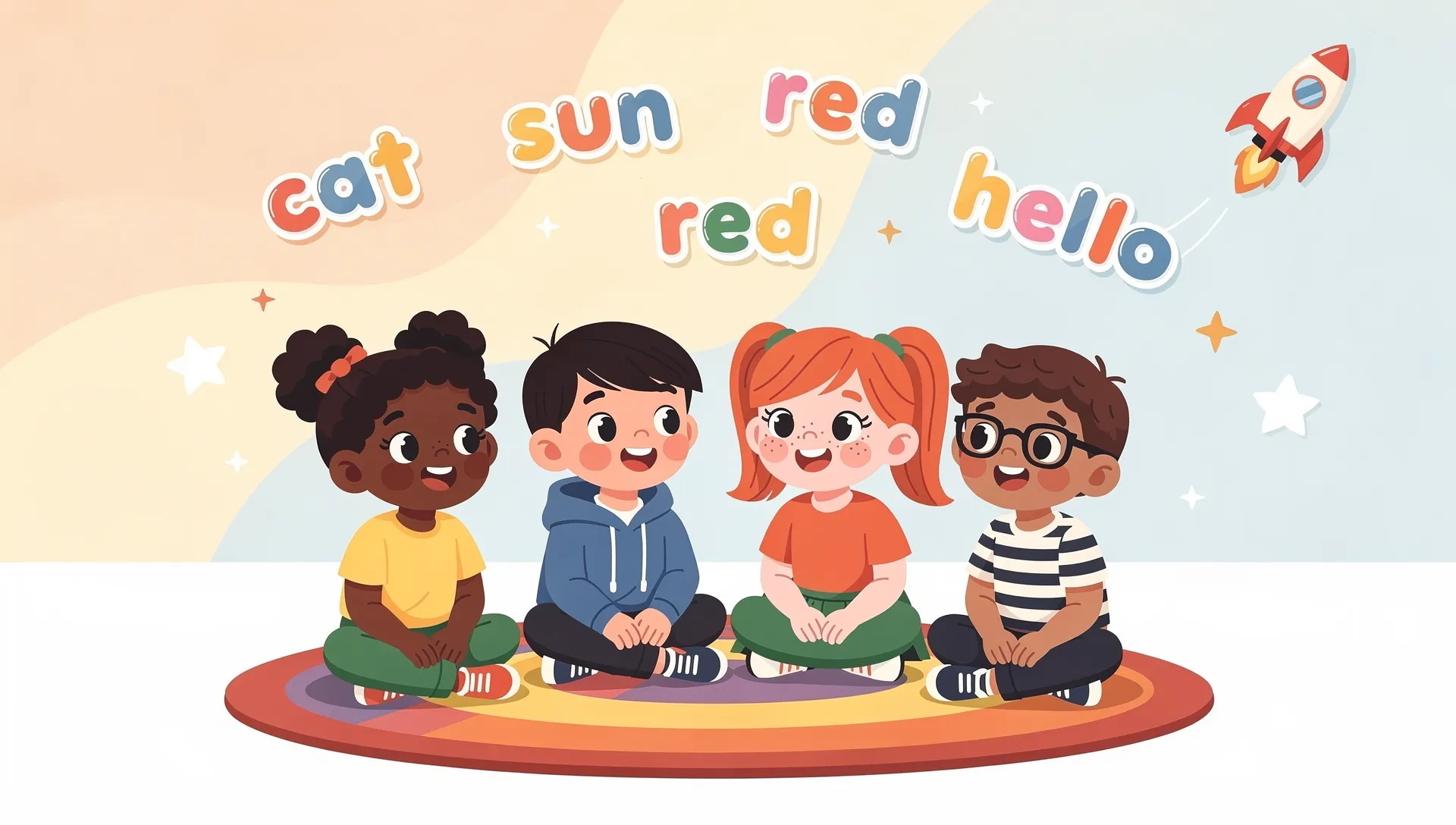
First 100 English Words Every Child Should Know (Free Printable PDF)
Here's a number that might surprise you: children who know just 100 core words before starting school can understand roughly 50% of everyday English conversation. That's not a typo. Research from the British Council and the Council of Europe consistently shows that a small set of high-frequency vocabulary gives young learners a real head start.
But which 100 words? And how do you teach them without turning your living room into a classroom?
We've done the work for you. The list below comes directly from Small Universe's Pre-A1 curriculum, the same word set used by thousands of kids learning English through our space-themed app. Every word was picked based on how often kids actually encounter it and whether it's useful in daily life.
And yes, there's a free printable PDF at the bottom. No sign-up wall, no tricks.
Why these 100 words matter
Not all vocabulary is created equal. A child who learns "elephant," "red," and "hello" will use those words hundreds of times before they ever need "chandelier." The words on this list share three things.
They're high frequency. These are words children hear daily in books, songs, cartoons, and conversation. They form the base that makes everything else easier to pick up.
They're concrete. Cognitive science tells us abstract words are tough for young brains. A three-year-old can point at a "nose" or hold up "two" fingers. That physical connection is how early vocabulary sticks.
They're grouped by theme. Cognitive science tells us that words learned in related clusters are remembered better than random lists. That's why we organize by category, not alphabetically. (For a themed example, check out our space vocabulary list for kids.)
In Small Universe, your child learns these exact words during the Earth planet, the first stage of the app's space exploration journey. Each word appears across multiple game types, from matching and memory to bubble pop and drag-and-drop, so kids encounter every word at least seven times before moving on.
Try the Earth planet free in Small Universe
The 100 words, organized by theme
We've selected the 10 most essential words from each of 10 categories. These are the words your child will get the most mileage from, whether they're 3 or 8 years old.
1. Greetings and polite words
These are the words kids need from day one. They open doors (literally and socially).
| # | Word | Why it matters |
|---|---|---|
| 1 | Hello | The universal opener |
| 2 | Goodbye | Every parting is practice |
| 3 | Yes | Agreement and understanding |
| 4 | No | Boundaries and choices |
| 5 | Please | Politeness in any culture |
| 6 | Thank you | Gratitude builds connection |
| 7 | Sorry | Empathy starts here |
| 8 | Good morning | Daily routine language |
| 9 | Good night | Bedtime ritual vocabulary |
| 10 | Help | Safety and communication |
Four-year-old Mia started learning English three months ago. Her parents speak Portuguese at home. One morning at nursery, she walked up to a teacher she'd never met, said "Hello! Good morning!" and the teacher's face lit up. That single moment, two words used in the right context, gave Mia the confidence to keep going. She now greets everyone she meets, in both languages.
2. Numbers
Numbers are everywhere: ages, birthdays, counting snacks, reading clocks. Kids who know their numbers in English have an instant bridge to math, games, and daily life.
| # | Word | # | Word |
|---|---|---|---|
| 1 | One | 6 | Six |
| 2 | Two | 7 | Seven |
| 3 | Three | 8 | Eight |
| 4 | Four | 9 | Nine |
| 5 | Five | 10 | Ten |
Start with fingers. Hold up three fingers, say "three." Then count toys, stairs, grapes. Numbers become real when they're attached to objects.
3. Colors
Colors are one of the easiest categories to teach because they're visible. Point at anything, name the color, done.
| # | Word | # | Word |
|---|---|---|---|
| 1 | Red | 6 | Purple |
| 2 | Blue | 7 | Pink |
| 3 | Green | 8 | Brown |
| 4 | Yellow | 9 | Black |
| 5 | Orange | 10 | White |
During a walk, try "I spy something... blue!" It's simple, free, and kids don't realize they're learning.
4. Animals
Kids are naturally fascinated by animals. These 10 cover the ones they'll encounter in books, zoos, and conversations most often.
| # | Word | # | Word |
|---|---|---|---|
| 1 | Elephant | 6 | Bear |
| 2 | Lion | 7 | Penguin |
| 3 | Monkey | 8 | Tiger |
| 4 | Giraffe | 9 | Panda |
| 5 | Zebra | 10 | Fox |
When six-year-old Tomas visited the London Zoo with his family, he could already name every animal in English after months of flashcard practice. The moment that mattered most? Standing in front of the penguin enclosure, turning to a British boy next to him, and saying, "Look! Penguin!" They spent ten minutes watching together, pointing and laughing. Tomas didn't need grammar. He needed one word at the right time.
5. Family
Family words are personal and emotionally loaded. They're also among the first words children want to say.
| # | Word | # | Word |
|---|---|---|---|
| 1 | Mother | 6 | Grandmother |
| 2 | Father | 7 | Grandfather |
| 3 | Sister | 8 | Baby |
| 4 | Brother | 9 | Family |
| 5 | Cousin | 10 | Uncle |
Try making a simple family tree poster with photos and English labels. Kids love seeing familiar faces paired with new words.
6. Body parts
Body vocabulary works well because children carry their "learning material" with them everywhere. Touch your nose, say "nose." It doesn't get more direct than that.
| # | Word | # | Word |
|---|---|---|---|
| 1 | Head | 6 | Hands |
| 2 | Eyes | 7 | Feet |
| 3 | Nose | 8 | Arms |
| 4 | Mouth | 9 | Legs |
| 5 | Ears | 10 | Hair |
"Simon Says" is hard to beat for body part vocabulary. "Simon says touch your nose!" gets kids moving and speaking at the same time.
7. Weather and seasons
Weather is the ultimate daily conversation topic, even for adults. Kids who know these words can describe what they see out the window every single morning.
| # | Word | # | Word |
|---|---|---|---|
| 1 | Sunny | 6 | Rainbow |
| 2 | Cloudy | 7 | Spring |
| 3 | Rainy | 8 | Summer |
| 4 | Snowy | 9 | Hot |
| 5 | Windy | 10 | Cold |
Every morning, look out the window together and describe the weather in English. "It's sunny today!" Three seconds. Big payoff over time.
8. Basic verbs
Verbs are what make language move. Even without perfect grammar, a child who says "want water" or "go park" is communicating clearly.
| # | Word | # | Word |
|---|---|---|---|
| 1 | Go | 6 | Have |
| 2 | Come | 7 | Give |
| 3 | See | 8 | Make |
| 4 | Want | 9 | Open |
| 5 | Like | 10 | Close |
Why these verbs? They're the ones that combine with everything. "Want milk," "go home," "open door," "see bird." A child with ten verbs and fifty nouns can say hundreds of things.
9. Food
Food vocabulary is motivating for obvious reasons. Kids care about what they eat, and mealtimes happen three times a day.
| # | Word | # | Word |
|---|---|---|---|
| 1 | Apple | 6 | Milk |
| 2 | Banana | 7 | Water |
| 3 | Bread | 8 | Egg |
| 4 | Rice | 9 | Chicken |
| 5 | Cheese | 10 | Cake |
We added this category to round out the 100. These food words appear throughout Small Universe's Earth curriculum in market and food-themed lessons.
10. Everyday objects
These are the things kids interact with daily. Knowing these words lets them label their own world.
| # | Word | # | Word |
|---|---|---|---|
| 1 | Ball | 6 | Chair |
| 2 | Book | 7 | Door |
| 3 | Bed | 8 | Cup |
| 4 | Shoe | 9 | Bag |
| 5 | Table | 10 | Hat |
How to practice at home (5 tips that actually work)
You don't need to be a teacher. You don't even need to be fluent. Here's what works:
1. Label the house
Stick small labels on objects around your home: "door," "table," "chair," "bed." Your child will read them dozens of times a day without any effort. After a week, they just know.
2. Use the "one word upgrade"
During normal conversation in your home language, drop in one English word. Instead of asking your child to bring their shoes, say, "Bring your shoes, please." Just the word "shoes" in English, surrounded by their native language. Low pressure, high exposure.
3. Make it physical
Jump when you say "jump." Point to your nose when you say "nose." Touch something cold when you say "cold." The body-word connection is one of the strongest memory pathways in young children. Researchers call it Total Physical Response, and it works remarkably well for ages 3-7.
4. Five-minute daily sessions
Long study sessions backfire with young kids. Five minutes of focused, playful English practice beats thirty minutes of forced worksheets every time. For more hands-on ideas, see our tips on how to teach English to preschoolers. Use one category per day. Monday is animals, Tuesday is colors, Wednesday is numbers. Keep it predictable and short. (Need a ready-made structure? See our 15-minute daily English routine.)
5. Use an app that does the heavy lifting
This is where we'll be honest about our bias: Small Universe was built specifically to solve this problem. (See our roundup of the best English games for kids for more options.) The app cycles through these 100 words (and hundreds more) across 17 different game types, using spaced repetition to make sure words actually stick. Your child plays space exploration games. The curriculum runs invisibly underneath.
Download Small Universe free and start with the Earth planet
What does CEFR Pre-A1 mean? (the simple version)
You might have noticed we mentioned "Pre-A1" earlier. Here's what that means in plain language.
The CEFR (Common European Framework of Reference for Languages) is the international standard for measuring language ability. It runs from Pre-A1 (absolute beginner) to C2 (native-like fluency). It's used by schools, universities, and language programs in over 40 countries.
Pre-A1 is the very first level. If you're wondering whether your child is ready to start, our guide on when to start learning English covers the research. A child at Pre-A1 can:
- Recognize and say individual words (not full sentences yet)
- Understand simple instructions like "sit down" or "open your book"
- Point to pictures and name what they see
- Respond to basic yes/no questions
The 100 words in this article cover the core Pre-A1 vocabulary. Once your child knows these, they're ready to start combining words into short phrases, which is the beginning of A1.
In Small Universe's curriculum:
| Level | Planet | Words learned | What your child can do |
|---|---|---|---|
| Pre-A1 | Earth | ~300 words | Name objects, animals, colors, body parts |
| A1 | Mars | ~500 words | Simple sentences, basic questions |
| A2 | Jupiter | ~1,000 words | Describe routines, talk about the past |
The 100 words in this printable are the starting point of the Earth planet journey.
What comes after the first 100?
Once your child is comfortable with these words, the next step isn't memorizing another 100 random words. It's going deeper.
Words turn into phrases. "Red" becomes "the red ball." "Want" becomes "I want water." "Go" becomes "let's go to the park." That's the natural move from Pre-A1 to A1.
Recognition turns into production. First, kids learn to recognize a word when they hear it or see it. Then they learn to say it themselves. Then they use it in context. Good learning programs build all three stages in.
Categories turn into connections. Instead of knowing "sunny" as an isolated weather word, your child starts saying "It's sunny, I want to go outside." Words link together into real communication.
Seven-year-old Yuki knew all 100 words on this list after four months of practice. Her turning point wasn't learning word number 101. It was the day she combined three words she already knew: "Daddy, look, rainbow!" She was standing at the window during a rainstorm, and she chose English to share her excitement. That's when her parents knew the vocabulary had become real.
From here, each new word gets easier because it connects to something your child already knows.
Explore the full Pre-A1 to B1 curriculum in Small Universe
Download the free printable PDF
We've put all 100 words into a clean, colorful, print-friendly PDF. It includes:
- All 10 categories with illustrations
- A pronunciation guide for non-native-speaking parents
- A progress checklist so your child can mark off words as they learn them
- Age recommendations (which words to start with at 3, 5, and 7)
Your child can learn every word on this list interactively through Small Universe, a free space-themed English app that covers all 10 vocabulary categories across Earth's 14 lessons. No email, no ads, no account needed.
Try Small Universe free — learn all 100 words through play
Want a structured, game-based way to teach these words? Try Small Universe free. Your child will learn every word on this list (and 200 more) through the Earth planet's 16 space-themed lessons. Five minutes a day. No ads. No pressure. If your child is 3 or 4, see our guide to the best English apps for 3-4 year olds for more options.
Small Universe is a kids English learning app for ages 3-10, themed around space exploration. The curriculum follows CEFR standards from Pre-A1 to B1 across seven planets, with 17 game types designed to make vocabulary stick. Learn more at smalluni.com.
Try Small Universe free
17 game types. 7 planets. Zero ads. Your child learns English through space exploration.
Play free — no account needed