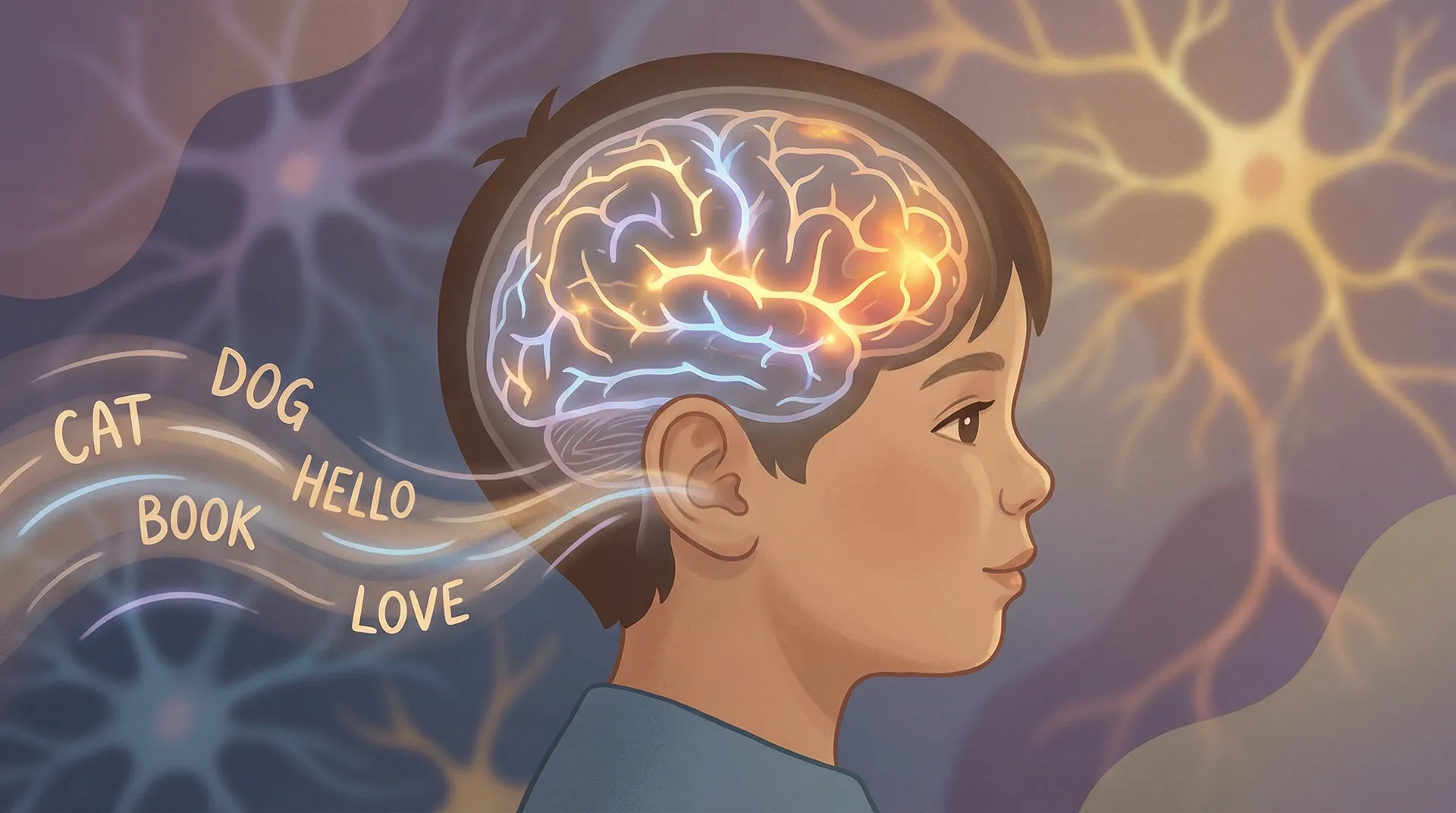
How Children's Brains Learn Language: A Parent's Guide to the Science
Your 3-year-old's brain is doing something right now that yours physically can't anymore.
Right this second, your child's brain is firing across regions that, in an adult, have long since settled into fixed patterns. It's building, pruning, and rewiring neural connections at a pace that will never be matched again in their lifetime. And the raw material for all of that construction? Language.
If you've ever wondered why your toddler picks up words from a cartoon she watched once, while you've been trying to remember the Spanish word for "airport" since 2014, the answer isn't that children are smarter. Their brains are built differently – temporarily, and urgently differently.
This article walks you through the four biggest ideas in language science, translated into plain English. No jargon exams. No footnotes you need a PhD to decode. Just the science that matters, and what it means when you're choosing how to support your child's language learning.
The window that closes: the critical period hypothesis
Here's a fact that keeps linguists up at night: a newborn baby can distinguish the sounds of every language on Earth.
Not just English and Spanish. Every language. Japanese pitch accents. The click consonants of Zulu. The tonal differences in Mandarin. Researchers have found that infants as young as three months old can perceive approximately 600 consonant sounds and 200 vowel sounds – the full phonetic inventory of human speech.
And then, slowly, the window starts to close.
What the brain does with sound
Between six and twelve months, the brain begins to specialize. It strengthens the neural pathways for sounds it hears every day and weakens the connections for sounds it doesn't encounter. Linguists call this "perceptual narrowing." Think of it like a sculptor chipping away marble: the brain removes what it doesn't need so that what remains works faster.
By about six months, babies start losing the ability to distinguish vowel sounds from languages they haven't been exposed to. By ten to twelve months, consonant distinctions follow. By the end of the first year, an infant's sound perception looks a lot like an adult's – tuned to their native language and increasingly deaf to foreign sounds.
This is the Critical Period Hypothesis, first proposed by neurologist Eric Lenneberg in 1967. The core idea is straightforward: there is a biologically determined window, roughly from birth through puberty, during which the brain is uniquely primed for language acquisition. After that window narrows, learning a language is still possible – but it requires conscious effort rather than effortless absorption.
A story about two sisters
Consider two sisters, Maya and Elise. Maya's family moved to Seoul when she was four. Within a year, she was chatting with neighborhood kids in Korean, her accent nearly indistinguishable from a native speaker's. Elise, who was fourteen when the family moved, studied Korean diligently for years. She became fluent in vocabulary and grammar, but her pronunciation always carried a trace of her English-speaking origins.
Maya wasn't more talented than Elise. She was just earlier. Her brain was still in the window where sound patterns could be absorbed rather than memorized.
What this means for you
Recent research has nuanced the original hypothesis. A 2024 analysis found that while age has a strong effect on phonetic acquisition (accent and pronunciation), it has surprisingly little effect on vocabulary and grammar learning. The window matters most for sounds. Your child's young brain isn't just "good at languages." It's doing something with sound that will literally become impossible later.
This doesn't mean you need to panic about a ticking clock. For a detailed look at what the research says about timing, see our guide on when to start your child's English learning. Any exposure to a second language during early childhood, even modest, playful exposure, is building neural infrastructure that will pay dividends for decades.
Krashen's big idea: the input hypothesis
In 1982, a linguist named Stephen Krashen proposed an idea so simple it almost sounds obvious. Almost.
We acquire language when we understand messages that are slightly above our current level.
Not through grammar drills. Not through vocabulary flashcards. Not through memorizing verb conjugation tables. We acquire language the same way we learned our first language: by hearing and understanding real messages that stretch us just a little.
Krashen called this "comprehensible input" and gave it a formula: i+1. The "i" is where the learner is right now. The "+1" is one step beyond.
The swimming pool analogy
Think of it like a swimming lesson.
You'd never throw a child who can't swim into the deep end and shout instructions about arm rotation from the poolside. That's not comprehensible input. That's terror.
You also wouldn't keep a child who can already doggy-paddle in the kiddie pool indefinitely. There's no "+1" in water that only reaches your ankles.
The sweet spot – the place where real learning happens – is water that is just deep enough to be a challenge but not so deep that the child panics. The child can still touch the bottom if she stretches. She can see you standing nearby. The environment makes sense to her even though it pushes her.
That's i+1.
Why this changes everything about how you think about apps and tools
Most language learning products for children fall into one of two traps.
Trap one: the flashcard factory. These tools drill isolated words with no context. "Apple. Say apple. Good. Banana. Say banana." There's no message being understood. No story, no meaning, no communication. The child is memorizing, not acquiring.
Trap two: the firehose. These tools dump full-speed native content on young learners – cartoons, songs, or conversations miles beyond their comprehension level. Research on screen time and language learning confirms that passive video content is far less effective than interactive, level-appropriate input. The input is real, but it isn't comprehensible. The child hears noise, not language.
Krashen's research suggests that the most effective approach sits between these extremes. Content should be understandable – the child should grasp the overall meaning – but should consistently include vocabulary and structures that are just beyond what the child already knows.
This is one of the reasons that level-based progression systems matter so much. When a learning tool follows a framework like the Common European Framework of Reference (CEFR), it's essentially building a staircase of i+1 steps. Each level introduces vocabulary and structures that assume the previous level has been absorbed. Each step is comprehensible because the foundation beneath it is solid.
The research holds up
A 2025 study in Frontiers in Education tested whether sustained exposure to level-aligned input could produce measurable gains in spoken language skills. It did. The principle works not because it's complicated but because it mirrors what the brain is already trying to do: make sense of the world one step at a time.
Piaget's stages: what your child can actually process
If Krashen tells us what to teach, Jean Piaget tells us how the child's brain can receive it.
Piaget was a Swiss psychologist who spent decades observing how children think – not just what they know, but how they know it. His developmental stages are one of the most replicated findings in psychology, and they have direct implications for language learning.
The three stages that matter for language
Sensorimotor Stage (birth to 2 years)
In this stage, children learn through their senses and physical actions. Language isn't yet symbolic – a word isn't separate from the object it represents. When a baby hears "ball," she doesn't think of the concept of a ball. She thinks of that specific ball, right there.
What works: Concrete, physical, sensory input. Songs with gestures. Words paired with objects the child can see and touch. Repetition – lots of it.
What doesn't work: Abstract concepts, written words, screens without interaction.
Preoperational Stage (2 to 7 years)
This is where it gets interesting. Children develop symbolic thinking – they understand that a word represents something. They start using language to express ideas, tell stories, and ask the question that defines this stage: "Why?"
But their thinking is still concrete and egocentric. They struggle with abstraction, logic, and seeing other perspectives. A child in this stage can tell you "the dog is big" but can't yet process "the dog is bigger than the cat but smaller than the horse."
What works: Visual learning, stories with clear narratives, imaginative play, games with tangible outcomes. Matching pictures to words. Acting out vocabulary. Characters and worlds that make abstract concepts feel concrete. (See our guide to the best English apps for 3-4 year olds for tools designed around this stage.)
What doesn't work: Grammar explanations, abstract rules, dense text.
Concrete Operational Stage (7 to 11 years)
Now children can think logically about concrete events. They can categorize, compare, and understand cause and effect. Sentence structure starts making sense to them. They can handle more complex games, puzzles, and problem-solving.
What works: Word-building challenges, sentence construction games, pattern recognition, reading comprehension, vocabulary in context. Games that reward strategic thinking. (See our guide to the best English apps for 5-7 year olds for tools that match this stage.)
What doesn't work: Rote learning without purpose, materials that feel "babyish," activities that don't challenge them.
A story about age-appropriate design
A few years ago, a well-meaning parent downloaded a language app designed for ages "3 to 12" and set her 4-year-old up with it. The app had beautiful animations and a cheerful mascot. It also required the child to read sentences, drag words into grammatically correct order, and identify verb tenses.
The child loved the mascot. She hated the activities. Within a week, she refused to open the app.
The problem wasn't motivation. The app was asking her preoperational brain to do concrete operational tasks. Like giving a toddler a bicycle with no training wheels and wondering why she won't ride.
Age-gating – designing different activities for different developmental stages – isn't a limitation. It's a prerequisite for effective learning.
Vygotsky's sweet spot: the Zone of Proximal Development
Lev Vygotsky, a Russian psychologist working around the same time as Piaget, had a complementary insight. While Piaget mapped what children can do at each stage, Vygotsky asked a different question: What can a child do with just a little bit of help?
His answer was the Zone of Proximal Development, or ZPD.
Three circles
Imagine three concentric circles.
The inner circle contains everything your child can already do independently. She can name colors in English. She can count to ten. She can say "hello" and "goodbye." Comfortable and safe, but not where learning happens.
The outer circle contains everything that is currently beyond her reach, even with help. Complex grammar, advanced vocabulary, abstract reasoning. Spending time here leads to frustration, not learning.
The middle ring – the ZPD – is the space between the two. These are the tasks your child can't do alone yet but can do with the right support. She can't construct a full sentence on her own, but if you give her the first three words and let her fill in the last one, she can do it. She can't read a paragraph, but she can match a spoken word to a picture.
This middle ring is where real learning lives.
Scaffolding: the art of support that disappears
The term educators use for providing help within the ZPD is "scaffolding" – and the metaphor is precise. Construction scaffolding is temporary. It supports the building while it's going up, then gets removed once the structure can stand on its own.
Good scaffolding in language learning works the same way. It provides just enough support for the child to succeed, and then it gradually pulls back as the child internalizes the skill.
Here's what scaffolding looks like in practice:
- A game that shows a picture alongside a new word, then later shows only the word.
- An activity that lets a child hear a sentence before asking her to build it, then eventually asks her to build it from memory.
- A system that mixes mostly familiar content with a smaller proportion of new material, so the child always has a foothold.
Vygotsky's insight connects directly to Krashen's i+1. The "+1" isn't arbitrary. It's the upper edge of the ZPD – the next thing the child is ready to learn, given the right support.
Why this matters more than "difficulty settings"
Many apps offer "easy, medium, hard" difficulty toggles. Better than nothing, but it misses the point. A true ZPD-aligned system doesn't ask the parent to guess the right difficulty. It observes where the child is, identifies what she's ready for next, and adjusts in real time.
The best language tools use adaptive difficulty engines that track which words a child knows solidly, which she is still learning, and which are just entering her awareness. Then they mix those categories in precise proportions – a concept educators sometimes call the "60/30/10 rule." Roughly 60% of content should be familiar (building confidence), 30% should be recently learned (reinforcing memory), and 10% should be new (pushing growth).
That ratio keeps the child in her ZPD without anyone needing to flip a switch.
Growth mindset and language: how you praise changes everything
Carol Dweck, a psychologist at Stanford, has spent four decades studying a single question: why do some children embrace challenges while others avoid them?
Her answer reshaped education: it comes down to what children believe about their own abilities.
Two types of belief
Children with a fixed mindset believe intelligence and talent are static. You're either "good at languages" or you're not. When these children encounter difficulty – a word they can't remember, a sentence they can't build – they interpret it as evidence that they're not good enough. They give up.
Children with a growth mindset believe abilities can be developed through effort, strategy, and practice. When they struggle, they interpret it as part of the learning process. They try again.
Here's the striking part: Dweck's research shows that the type of praise children receive directly shapes which mindset they develop.
The praise experiment
In a landmark study, Dweck and her colleagues gave children a simple puzzle to solve. Afterward, half the children were praised for intelligence: "You got eight right. You must be really smart at this." The other half were praised for effort: "You got eight right. You must have worked really hard."
Then both groups were offered a choice: a harder puzzle or an easy one.
The children praised for intelligence overwhelmingly chose the easy puzzle. They didn't want to risk looking "not smart." The children praised for effort chose the harder one. They wanted to keep learning.
The implications for language learning are hard to overstate.
What to say (and what not to say)
When your child is learning English and gets a word right:
- Instead of: "You are so smart!"
- Try: "You remembered that word! You've been practicing."
When your child gets something wrong:
- Instead of: "That is okay, languages are just hard for some people."
- Try: "That was a tricky one. Let's try it again a different way."
When your child doesn't want to practice:
- Instead of: "You are so good at this, just do a little more."
- Try: "I noticed you figured out that last word even though it was tough. That's what learning looks like."
A longitudinal study found that mothers who gave more "process praise" when their children were toddlers had children who, five years later, showed stronger growth mindsets and better academic performance in reading and math.
The words you use today are shaping the learner your child will be in five years. That's not a metaphor.
What this means for learning tools
Any app or tool your child uses is also "praising" them – through its feedback systems, reward structures, and the way it handles mistakes.
A tool that celebrates correct answers with "You are a genius!" is training a fixed mindset. A tool that says "Great effort!" or "You are getting stronger!" is training a growth mindset. A tool that treats wrong answers as learning opportunities rather than failures – offering another attempt instead of a penalty – is teaching resilience.
Look at the feedback language. It matters more than you might think.
What all this means for choosing a language learning tool
You now have a scientific framework for evaluating any language learning product – app, class, tutor, or curriculum. Here's what to look for.
1. Does it follow a structured progression? (Krashen's i+1)
The tool should have a clear path from simpler to more complex language. Each level should build on the last. Content should be understandable but stretching. Frameworks like the CEFR (Common European Framework of Reference) provide this structure, mapping learners from absolute beginner through intermediate and beyond.
If an app just throws random vocabulary at your child with no progression, it's ignoring the most basic principle of how language acquisition works. Our roundup of the best English games for kids highlights tools that get this right.
2. Does it match your child's developmental stage? (Piaget)
A 4-year-old and an 8-year-old learn differently – not just at different speeds, but in fundamentally different ways. The tool should offer age-appropriate activities: picture matching and sensory play for younger children, word building and sentence construction for older ones.
Beware of "ages 3-12" products that give everyone the same experience. If your 4-year-old is doing grammar drills, or your 9-year-old is stuck tapping pictures of apples, the tool isn't aligned with developmental science.
3. Does it adapt to your child's level? (Vygotsky's ZPD)
The best tools don't rely on parents to set difficulty. They observe, adjust, and meet the child where she is. They mix familiar content with new challenges in proportions that keep the child in her Zone of Proximal Development – challenged but not overwhelmed, supported but not bored.
Look for adaptive difficulty, spaced repetition, and intelligent mixing of review and new material.
4. Does it praise effort over talent? (Dweck's growth mindset)
Check the feedback language. Does the app say "You are so smart" or "You worked hard on that"? Does it punish mistakes or treat them as part of the process? Does it encourage the child to try again or mark the answer wrong and move on?
The feedback system isn't a cosmetic feature. It's shaping your child's relationship with learning itself.
5. Does it start early and use real language? (critical period)
Every day of early exposure matters. The tool doesn't need to produce fluency by age five – but it should be giving your child's brain the raw material it needs while the neural window is widest. Real words, real phrases, real communication – not just isolated vocabulary drills.
How Small Universe approaches these principles
We built Small Universe on these research principles, not as afterthoughts.
Krashen's i+1 in practice. Our curriculum follows the CEFR framework across seven planets. Earth covers Pre-A1 (the first 300 words). Mars builds to A1. Neptune, Jupiter, Uranus, and Pluto progress through A2. Saturn extends to B1. Each lesson introduces 8 to 15 new words that build on previous learning. Every game session uses a 60/30/10 mix: 60% familiar words for confidence, 30% recently learned words for reinforcement, and 10% new words for growth. That ratio is i+1 in action.
Piaget's stages in the game design. Our 17 game types are age-gated. A 3-year-old plays picture matching, bubble pop, and memory flip – visual, tactile, sensory games that align with preoperational thinking. A 9-year-old unlocks word builder, sentence scramble, and conversation simulation – games that require logical sequencing and pattern recognition. The Game Wheel automatically selects compatible games based on the child's age. We don't ask a 4-year-old to do what only a 7-year-old's brain can process.
Vygotsky's ZPD through adaptive difficulty. Our difficulty engine tracks performance at the session level and adjusts in real time. If a child is breezing through, the mix shifts to include more new material. If she's struggling, it increases the proportion of familiar content and adds more scaffolding – picture hints, audio cues, slower pacing. The system finds and maintains the ZPD without any parent configuration required.
Dweck's growth mindset in our reward system. Our celebration screen praises effort and persistence, not innate ability. Stars reflect engagement and practice, not perfection. Wrong answers are learning moments – the child gets to try again with additional support rather than receiving a penalty. The companion character evolves based on consistent practice, reinforcing that growth comes from showing up, not from being "naturally talented."
Explore Small Universe and see these principles in action – free to start.
5 practical takeaways you can use today
You don't need an app to apply this science. Here are five things you can do starting right now.
1. Talk more, and talk to your child.
Research consistently shows that children whose parents speak more to them develop larger vocabularies earlier. But quantity alone isn't the key – interaction is. Children who follow an adult's gaze and engage in back-and-forth conversation pick up significantly more vocabulary in their first two years than children who simply overhear adult speech. Narrate your day. Ask questions, even to a baby. Wait for responses, even nonverbal ones.
2. Aim for "just beyond" in everything.
Whether you're reading a book, playing a game, or chatting at dinner, try to include language that's slightly beyond what your child already knows. If she knows "dog," introduce "puppy" and "bark." (Our first 100 English words list is a great starting point for building this foundation.) If she can say "I want milk," model "I would like some milk, please." You're providing i+1 without even thinking about it.
3. Match the activity to the child, not the child to the activity.
A 3-year-old learns through play, pictures, and songs – our guide on how to teach English to preschoolers covers this in detail. A 7-year-old can handle simple reading and writing games. A 10-year-old is ready for conversation practice and storytelling. Don't push activities that require cognitive abilities your child hasn't developed yet. It doesn't accelerate learning. It creates frustration.
4. Praise the process, every single time.
"You kept trying even when it was hard." "You figured out a new way to say that." "I noticed you practiced that word three times." These sentences are building a growth mindset that will serve your child in every area of learning for the rest of her life. Drop "you are so smart" from your vocabulary. Replace it with "you worked so hard on that."
5. Start now. Any amount counts.
The critical period isn't a cliff. Your child's brain doesn't suddenly lose its language-learning advantage on a specific birthday. But the window is real, and earlier exposure builds stronger neural foundations. Even ten minutes a day of meaningful second-language exposure is doing more than you can see.
The big picture
Here's what all four theories share: children aren't empty vessels waiting to be filled with knowledge. They're active, pattern-seeking beings whose brains are designed to learn language – but only when the conditions are right.
The right level. The right support. The right feedback. The right timing.
When those conditions line up, a child who started with zero words in a language begins to think in it, dream in it, and make jokes in it. Not because she was drilled, but because her brain did what it was built to do.
Your job isn't to teach your child a language. It's to create the conditions where acquisition happens on its own.
The science says those conditions are simpler than you'd expect.
Small Universe is a kids' English learning app for ages 3 to 10, themed around space exploration. With 17 game types across 7 planets, it follows the CEFR framework and uses adaptive difficulty to keep every child learning in their Zone of Proximal Development. Try it free at smalluni.com.
Frequently asked questions
How does a child's brain learn language?
Through three main processes: comprehensible input (hearing language slightly above their current level), pattern recognition (finding recurring structures in what they hear), and sleep consolidation (memories formed during waking hours are stabilized into long-term storage during sleep). This is why short, daily practice beats long, infrequent sessions.
What is Krashen's i+1 and how does it apply to kids?
Krashen's Input Hypothesis states that learners acquire language by encountering input just one step beyond their current level ("i+1"). For children, this means each session should include mostly familiar words for confidence, some recently learned words for reinforcement, and a small number of genuinely new words. Our 60/30/10 session mix implements this directly.
Why do young children learn languages faster than adults?
Because the critical period for language acquisition gives children distinct neurological advantages: they perceive more phonemes (including sounds not in their native language), form new sound patterns with less interference from existing language, and have more neural plasticity for grammar acquisition. These advantages diminish gradually through childhood and more sharply after puberty.
How important is repetition in children's language learning?
Very. Research suggests children need 10–20 meaningful encounters with a word across different contexts before it enters active vocabulary. A single lesson isn't enough. This is why spaced repetition — revisiting words across multiple sessions — is the mechanism behind most evidence-based language programs for children.
Try Small Universe free
17 game types. 7 planets. Zero ads. Your child learns English through space exploration.
Play free — no account needed