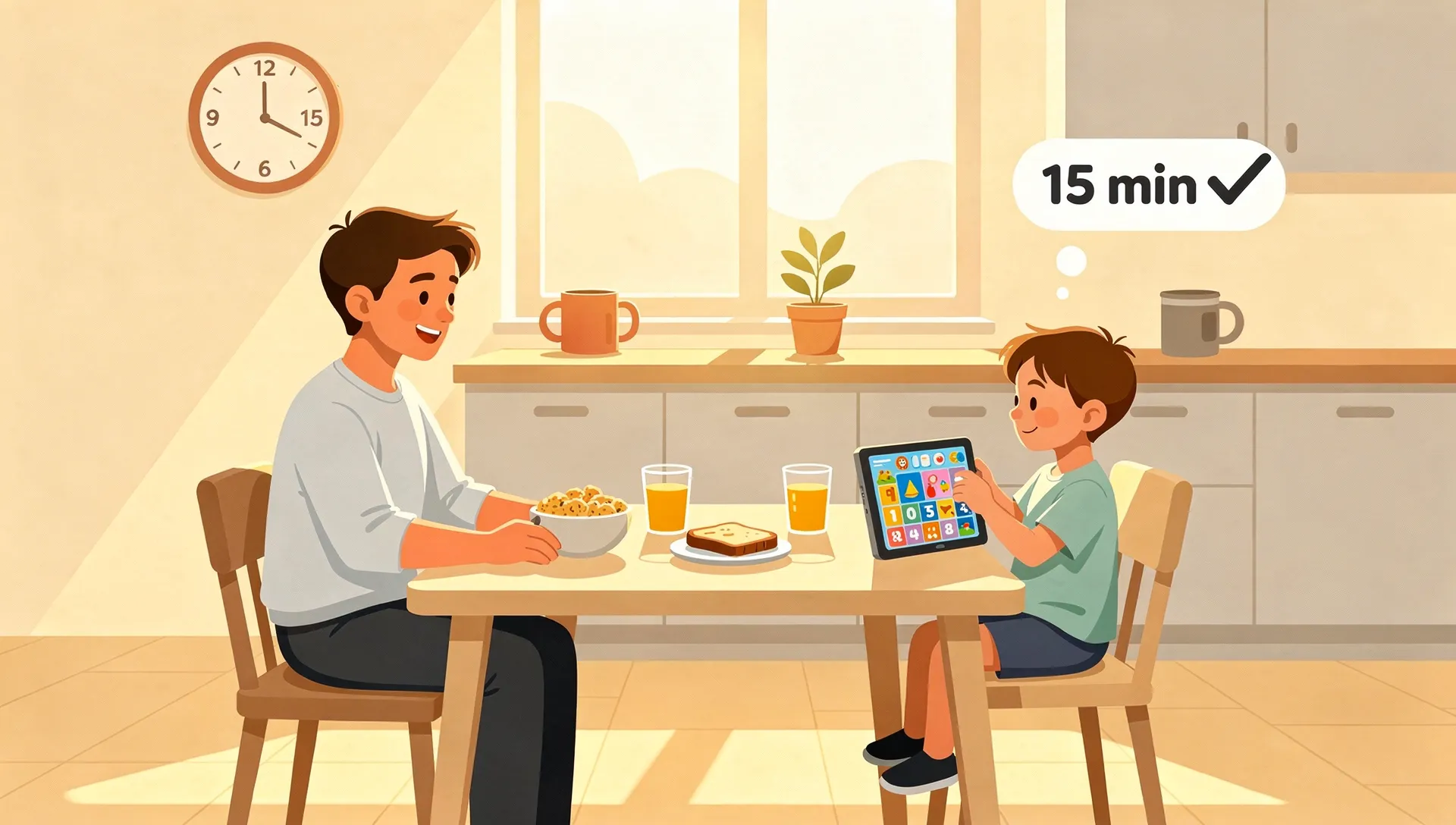
The 15-Minute Daily English Routine for Kids That Actually Works
Last Tuesday, Maria sat down with her 5-year-old son, Leo, for what she planned as a solid hour of English practice. Flashcards were spread across the table. A worksheet was printed. A YouTube playlist was queued up.
By minute twelve, Leo was under the table.
By minute twenty, he was crying. Maria was frustrated. The flashcards were on the floor. Another "English time" had ended in tears, and Maria started wondering if maybe her son just wasn't ready for a second language.
Then a friend told her: "Stop doing an hour. Do fifteen minutes."
Two weeks later, Leo was asking for English time. Not because Maria forced it, but because fifteen focused minutes felt more like play than school. He was retaining more words. He was building sentences. And nobody was crying.
This isn't a miracle. It's how the brain actually learns language. Research shows that starting early matters, and a short daily routine is one of the best ways to make the most of your child's natural learning window.
Why 15 minutes beats 1 hour
If you've been trying to teach your child English at home with long, structured sessions, you're working against the way young brains process language. Here's why shorter wins.
The science backs this up. Research on spaced repetition and memory consolidation shows that the brain retains new vocabulary far better through short, consistent daily practice than through infrequent longer sessions. A 2019 study in the Journal of Experimental Child Psychology found that children who practiced vocabulary in short daily bursts outperformed those who studied for the same total time in fewer, longer sessions.
Attention spans are real limits, too. A 4-year-old can focus for roughly 8 to 12 minutes. A 7-year-old can sustain around 14 to 21 minutes. Asking a young child to do an hour of English is like asking an adult to run a marathon without training. It doesn't build endurance. It builds dread.
And consistency beats intensity. Fifteen minutes a day, seven days a week, gives you 105 minutes of weekly practice. That's nearly two hours, distributed across the week so each session builds on the previous day's memory before it fades. Most families who attempt longer sessions manage two or three per week at best before giving up.
The results come fast, too. Parents who stick with a daily 15-minute routine typically see their child using new words spontaneously within two weeks. That early progress creates a positive feedback loop: the child feels successful, so they want to do it again.
The 3-part routine: your daily 15 minutes
Here's the structure. No guesswork, no planning. Three parts, every day.
Part 1: Warm-up conversation (5 minutes)
No screens, no materials. Just you and your child talking.
Pick one simple question or prompt and explore it together in English. The goal isn't perfection – it's getting comfortable hearing and producing English sounds in a low-pressure setting.
Sample warm-up prompts:
- "What did you eat for breakfast? Was it yummy?"
- "Look outside. What color is the sky right now?"
- "If you could be any animal today, which one?"
- "Can you count the blue things in this room?"
- "What is your favorite word? Why do you like it?"
Keep it conversational. If your child answers in their first language, gently echo back in English. If they don't know a word, supply it cheerfully and move on. This is warm-up, not a test.
Part 2: App lesson (5-7 minutes)
This is the core learning block. One lesson in Small Universe takes five to seven minutes and covers structured vocabulary practice through one of 17 game types, from matching and memory flip to word building and sentence scramble.
Why an app lesson works as the centerpiece: the difficulty adjusts to your child's level automatically, so you don't need to plan what to teach next. The Game Wheel spins to select a different game type each session, so Tuesday's lesson feels different from Monday's even when they're practicing the same vocabulary. Your child sees themselves advancing through planets (Earth to Mars to Jupiter to Saturn), and built-in spaced repetition brings words back at the right intervals for long-term retention.
One lesson. One game. Five to seven minutes. That's all you need for the structured part. For more ideas on game-based learning, see our roundup of the best English games for kids.
Try a free Small Universe lesson and see how it fits into your routine.
Part 3: Quick review (3 minutes)
Close the loop. After the app lesson, spend three minutes reinforcing what your child just practiced. This is where short-term memory starts converting to long-term memory.
Three review techniques, each about 60 seconds:
- Recall. "Can you remember three words from your lesson?" No peeking. If they get stuck, give a hint ("It was an animal that says 'moo'").
- Silly sentence. Take one word from the lesson and make the silliest sentence you can. "The ELEPHANT is eating my SPAGHETTI!" Laughter helps memory.
- Point-and-name. Walk around the room and point at objects. "What is this in English?" Mix in easy wins with one or two new words.
That's it. Fifteen minutes. Conversation, structured practice, review. Done.
Age-specific tweaks
The 3-part structure stays the same across ages. But how you execute each part should shift based on your child's developmental stage.
Ages 3-4: Keep it physical and playful
At this age, learning happens through the body as much as the mind. Sitting still for fifteen minutes isn't realistic, and it isn't necessary.
For the warm-up, use objects, not abstract questions. Hold up a banana: "What is this? What color is it? Is it big or small?" Let them touch, hold, and interact with whatever you're talking about. Sing a short English song together – "Head, Shoulders, Knees and Toes" is a classic for a reason.
For the app lesson, stick to five minutes maximum. Small Universe's matching and bubble pop games work well at this age because they need simple taps and give immediate visual rewards. Sit with your child and narrate what's happening on screen. "Oh, you found the CAT! Great job!"
For the review, make it a movement game. "Can you jump to something RED?" "Can you hop like a FROG?" Physical responses show comprehension even before a child can produce English words.
Earth in Small Universe is designed for Pre-A1 learners and introduces basic nouns in sets of 8-10 words per lesson, which is about the right cognitive load for this age group. For more app recommendations at this stage, see our guide to the best English apps for 3-4 year olds.
Ages 5-7: Add structure and choice
Children in this range are developing reading readiness and a sense of independence. They want to feel competent and in control. (For app recommendations at this stage, see our guide to the best English apps for 5-7 year olds.)
For the warm-up, introduce "Would you rather" questions. "Would you rather fly like a BIRD or swim like a FISH?" These require more complex thinking and produce longer English responses. Try a "Word of the Day" that you both use as many times as possible before bedtime.
For the app lesson, let your child choose their lesson or planet when possible. The full seven minutes works well here. Games like word builder, sentence scramble, and story mode become accessible and engaging. Step back and let them play independently, but stay nearby to celebrate wins.
For the review, try the "Teach Me" reversal – ask your child to teach you the words they just learned. Teaching is one of the most powerful memory techniques at any age. Ham it up. Pretend to get words wrong so they can correct you.
Ages 8-10: Build toward independence
Older children can handle more autonomy and benefit from understanding their own learning process.
For the warm-up, have a genuine mini-conversation in English. Talk about their day, a book they're reading, or something that happened at school. Try a "question chain" where you take turns asking each other questions in English.
For the app lesson, games like conversation simulation, picture dictation, and chain reaction challenge them with more complex language. They can track their own progress through Jupiter and Saturn, where vocabulary reaches 1,000+ words and includes past tense, conditionals, and comparisons.
For the review, start a shared "English journal." After each session, your child writes one sentence about what they learned. It can be as simple as "Today I learned the word TELESCOPE." Over weeks, the journal becomes a visible record of progress that keeps them going.
Your weekly schedule: 7 days of variety
Repetition doesn't have to mean monotony. Here's a sample weekly schedule that keeps the 3-part structure while varying the flavor each day.
| Day | Warm-Up Theme | App Focus | Review Activity |
|---|---|---|---|
| Monday | "Weekend recap" - What did you do? | New lesson (new vocabulary) | Recall Game - name 3 new words |
| Tuesday | "Color hunt" - Find colors around the house | Review previous lesson | Silly Sentence with yesterday's words |
| Wednesday | "Would you rather" questions | New lesson (new vocabulary) | Teach Me - child teaches parent |
| Thursday | "Counting game" - Count objects in English | Practice a challenging game type | Point-and-Name walk around the room |
| Friday | "Story starter" - make up a story together | New lesson (new vocabulary) | Draw a picture of one new word |
| Saturday | "Song time" - sing an English song | Free choice - child picks any lesson | Act out a word (charades style) |
| Sunday | "Week review" - what words do you remember? | Replay a favorite lesson | Write in English journal (ages 5+) |
Notice the rhythm: three new lessons per week, two review sessions, and two free-choice days. This balances new input with consolidation and gives your child ownership over weekend sessions.
You can print this schedule and stick it on the fridge. When the routine is visible, it becomes part of the family's daily rhythm rather than something that requires a decision each day.
When your child says "no"
It will happen. Even with a solid 15-minute routine, there will be days when your child resists. That doesn't mean the routine is failing. It means your child is a human being.
Here's how to handle the most common scenarios.
"I don't want to do English today."
Acknowledge the feeling, then shrink the ask. "That's okay. Let's just do the warm-up part. Two minutes. If you want to stop after that, we stop." Nine times out of ten, once they start, they continue. The hardest part is always the first thirty seconds.
Don't force it, bribe them with unrelated rewards, or make it a power struggle. The moment English becomes a battleground, you've lost months of progress.
"This is boring."
This usually means the content is too easy or too repetitive. In Small Universe, try switching to a different planet or game type. The app has 17 different game formats, so if matching feels stale, word hunt or alien translator will feel like a completely different experience. For the warm-up, let your child pick the topic.
Don't push through with the same material. Boredom is information. Listen to it.
"I'm not good at English."
This is the most important one to get right. Show them their progress. Scroll back through completed lessons. Look at the English journal. Remind them of words they know now that they didn't know a month ago. Say: "You're not bad at English. You're learning English. Those are two very different things."
Don't compare them to siblings, classmates, or other children. Ever.
The nuclear option: skip the day
Sometimes the right move is to skip. If your child is sick, exhausted, or having a genuinely terrible day, let it go. A single missed day doesn't break a habit. Forcing a miserable session on a bad day can. Say "We'll do our English adventure tomorrow" and move on without guilt.
The streak will survive. Your relationship with your child matters more than any streak.
Making it stick: habit stacking
The biggest threat to your 15-minute routine isn't your child's resistance. It's your own consistency. Life gets busy. Evenings fill up. You forget.
The fix is habit stacking – a technique from behavioral psychology where you attach a new habit to an existing one. Instead of remembering to "do English at some point today," you anchor it to something that already happens automatically.
A few stacks that work well: do English right after breakfast, before screen time ("First we do our English adventure, then you can watch your show"). Or after bath, before the bedtime story – the wind-down period is actually great for language retention because the brain consolidates memories during sleep. For school-age kids, after the snack and before homework is another natural slot.
Three tips for the first two weeks. First, same time, same place, every day – consistency of context helps the brain shift into "English mode" automatically, and the kitchen table at 7:15 AM becomes a trigger in itself. Second, set a phone alarm, not to time the session but to remind you to start it. Label it something your child will enjoy hearing. And third, track the streak visibly. A simple wall calendar where your child puts a sticker for each completed day works better than any app notification. After seven stickers in a row, the visual streak becomes its own motivation.
Start your family's 15-minute routine today with Small Universe. Your first planet is free.
The long view
Here's what fifteen minutes a day actually adds up to.
After one week, your child knows 24 to 36 new English words and is starting to use some of them on their own.
After one month, they've completed roughly 12 new lessons, building a working vocabulary of 100+ essential words. The routine feels automatic. You're no longer convincing them to start.
After three months, they're moving through their second planet. Sentences are forming. They're mixing English words into everyday conversation without thinking about it.
After one year, they've covered 150+ lessons and have a vocabulary approaching 500 to 1,000 words, equivalent to CEFR A1-A2. That's the same level many children reach after two to three years of school-based English instruction.
All from fifteen minutes a day.
No textbooks. No tutors. No tears. Just a short daily routine that respects how your child's brain actually works.
The best time to start was six months ago. The second best time is today, right after breakfast.
Download Small Universe and build your 15-minute routine around your first lesson.
Small Universe is a space-themed English learning app for kids ages 3-10. With 17 game types, 7 planets, and adaptive difficulty that grows with your child, it's designed to be the structured core of your family's daily English routine. Learn more at smalluni.com.
Try Small Universe free
17 game types. 7 planets. Zero ads. Your child learns English through space exploration.
Play free — no account needed