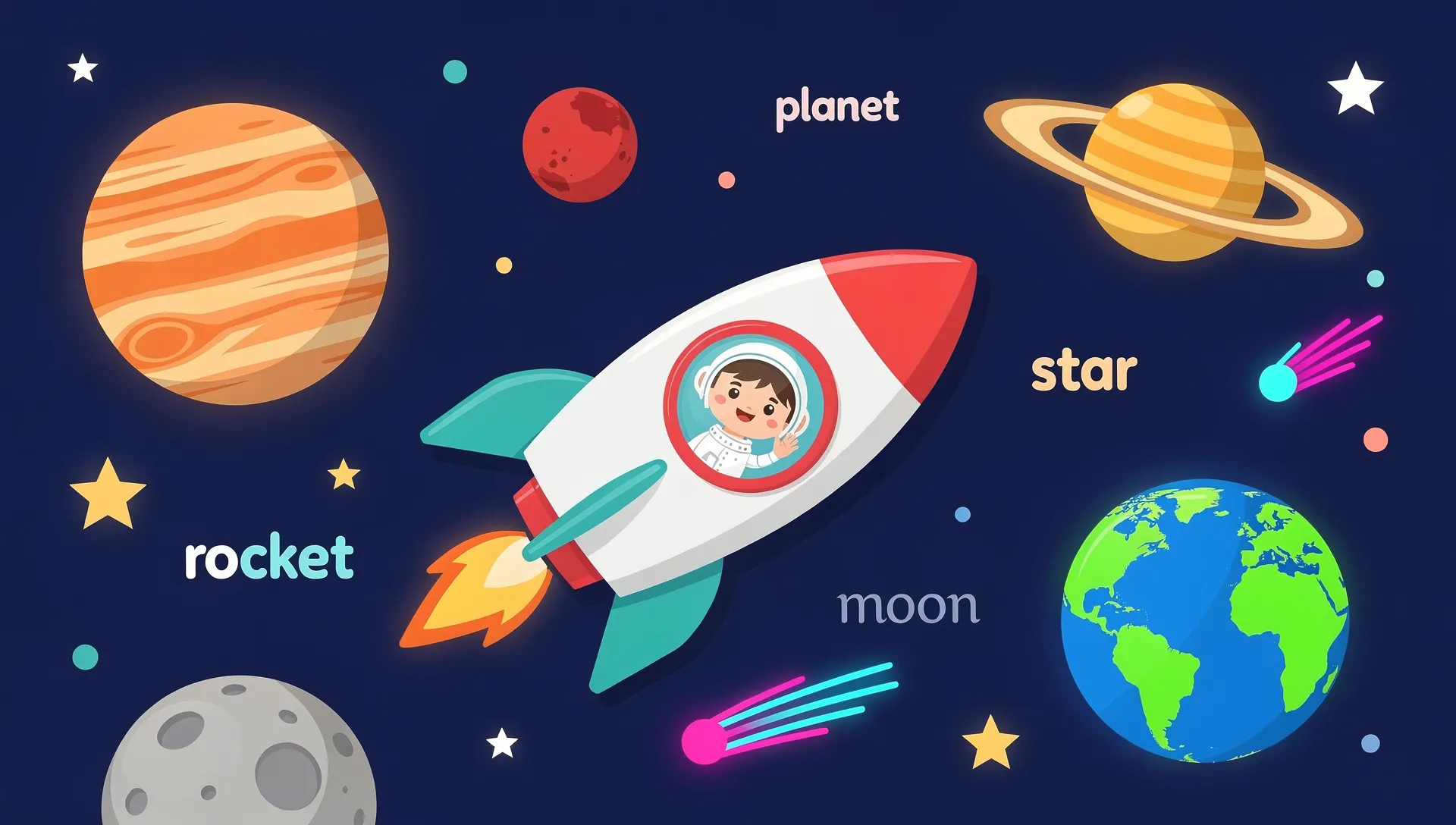
50 Space Words Every Kid Should Know (Free Printable Poster)
Your child can name every dinosaur species from the Triassic period. They know exactly which Pokemon evolves into what. But ask them to point out Jupiter in the night sky, and you get a blank stare.
Sound familiar?
Here's the good news. Space vocabulary is some of the most exciting language a child can learn. These words lead to real conversations about the biggest questions humans have ever asked. Where do stars come from? How far away is Mars? Could we really live on another planet one day?
We put together 50 space words every kid aged 3 to 10 should know, organized by category, with kid-friendly definitions and fun facts. And yes, there's a free printable poster at the bottom.
Why space words matter for kids
Learning space vocabulary isn't just about science class. It builds language skills that carry into every subject. The words on this list come from real astronomy — the same vocabulary used by NASA's education resources and the International Astronomical Union, the body that officially names objects in our solar system.
Space words pull a child's vocabulary into territory that feels thrilling rather than academic. When a five-year-old learns the word "orbit," they aren't just memorizing a definition. They're building a mental framework for understanding how things move, how systems work, how to describe forces you can't see.
Research on how children learn language consistently shows that children learn new words faster when those words connect to topics they actually care about. Few topics compete with outer space on that front. A child who learns "galaxy" at age four will remember it more easily than a child who learns "perimeter" at age eight, simply because the emotional pull is stronger.
For English language learners, space vocabulary has another advantage. The words are largely the same across cultures, the visuals are unmistakable, and the subject naturally motivates kids to keep going. If your child is just starting out, pair this list with our first 100 English words for kids to build a strong foundation.
50 space words every kid should know
Planets and moons
Six-year-old Mila was convinced the Moon followed her family's car at night. "It keeps chasing us!" she told her dad. That conversation turned into a twenty-minute talk about orbits, gravity, and why the Moon seems to move with you. All from one observation out the car window.
| # | Word | Kid-friendly definition | Fun fact |
|---|---|---|---|
| 1 | Planet | A very large, round object that travels around a star. | There are 8 planets in our solar system. Pluto got reclassified in 2006. |
| 2 | Earth | Our home planet, the only one we know has life. | Earth is the only planet not named after a Greek or Roman god. |
| 3 | Mars | The red planet, fourth from the Sun. | Mars has the tallest volcano in the solar system: Olympus Mons. |
| 4 | Jupiter | The biggest planet in our solar system. | Jupiter has 95 moons! Its Great Red Spot is a storm bigger than Earth. |
| 5 | Saturn | The planet famous for its beautiful rings. | Saturn's rings are made mostly of ice and rock. |
| 6 | Mercury | The smallest planet, closest to the Sun. | A year on Mercury is only 88 Earth days. |
| 7 | Venus | The hottest planet, even hotter than Mercury. | Venus spins backwards compared to most other planets. |
| 8 | Neptune | The farthest planet from the Sun, an ice giant. | Winds on Neptune reach 1,200 miles per hour. |
| 9 | Uranus | An ice giant that spins on its side. | Uranus rolls around the Sun like a ball instead of spinning like a top. |
| 10 | Moon | A natural object that travels around a planet. | Our Moon is slowly drifting away from Earth, about 1.5 inches per year. |
| 11 | Crater | A bowl-shaped hole made when a space rock hits a surface. | The Moon has millions of craters because it has no atmosphere to burn up incoming rocks. |
Stars and galaxies
| # | Word | Kid-friendly definition | Fun fact |
|---|---|---|---|
| 12 | Star | A giant ball of hot, glowing gas in space. | The Sun is a star. It just looks bigger because it is so much closer than other stars. |
| 13 | Sun | The star at the center of our solar system. | The Sun is so big that 1.3 million Earths could fit inside it. |
| 14 | Galaxy | A huge collection of stars, gas, and dust held together by gravity. | Our galaxy, the Milky Way, contains between 100 and 400 billion stars. |
| 15 | Constellation | A group of stars that form a picture or pattern in the sky. | There are 88 official constellations recognized by astronomers. |
| 16 | Milky Way | The galaxy where our solar system lives. | You can see the Milky Way on very dark nights as a cloudy band across the sky. |
| 17 | Supernova | A massive explosion when a huge star dies. | A single supernova can briefly outshine an entire galaxy of billions of stars. |
| 18 | Black hole | A place in space where gravity is so strong nothing can escape, not even light. | The nearest known black hole to Earth is about 1,560 light-years away. |
| 19 | Light-year | The distance light travels in one year, about 5.88 trillion miles. | It takes light about 4.24 years to reach us from the nearest star after the Sun. |
| 20 | Universe | Everything that exists: all of space, time, matter, and energy. | The observable universe is about 93 billion light-years across. |
| 21 | Nebula | A giant cloud of gas and dust in space where new stars are born. | The Orion Nebula is visible to the naked eye on clear winter nights. |
Spacecraft and equipment
Eight-year-old Noah built a "mission control" out of cardboard boxes in his living room. He had a "cockpit," a "launch pad," and a sign that read "NASA" in wobbly marker. His mom said he spent three days playing astronaut. He used every one of these words without anyone prompting him.
| # | Word | Kid-friendly definition | Fun fact |
|---|---|---|---|
| 22 | Rocket | A vehicle that uses burning fuel to blast into space. | Rockets must travel at 25,000 mph to escape Earth's gravity. |
| 23 | Astronaut | A person who travels to space. | The word "astronaut" comes from Greek words meaning "star sailor." |
| 24 | Satellite | An object that orbits a planet; can be natural (like the Moon) or human-made. | There are over 10,000 active satellites orbiting Earth right now. |
| 25 | Space station | A large structure in space where astronauts live and work. | The International Space Station orbits Earth 16 times every single day. |
| 26 | Telescope | A tool that makes faraway things look closer. | The James Webb Space Telescope can see galaxies that formed 13 billion years ago. |
| 27 | Spacesuit | Special clothing that protects astronauts in space. | A NASA spacesuit costs approximately 12 million dollars. |
| 28 | Rover | A robot vehicle that explores the surface of another planet. | NASA's Perseverance rover has been exploring Mars since February 2021. |
| 29 | Launch pad | The platform where a rocket takes off. | Kennedy Space Center's Launch Pad 39A has been used since the Apollo missions. |
| 30 | Mission control | The team on Earth that helps guide a space mission. | Mission control operates 24 hours a day during active missions. |
| 31 | Spacecraft | Any vehicle designed to travel in space. | The Voyager 1 spacecraft is the farthest human-made object from Earth. |
| 32 | Capsule | The part of a spacecraft where astronauts sit. | Early space capsules were tiny, with less room than the front seat of a small car. |
Space actions
| # | Word | Kid-friendly definition | Fun fact |
|---|---|---|---|
| 33 | Orbit | To travel around something in a curved path. | The Moon takes about 27 days to complete one orbit around Earth. |
| 34 | Launch | To send a rocket or spacecraft into the sky. | Countdowns were invented for a 1929 movie and NASA adopted the tradition. |
| 35 | Land | To arrive safely on a surface after flying. | The Apollo 11 Moon landing was watched by 600 million people worldwide. |
| 36 | Float | To drift without gravity pulling you down. | Astronauts on the ISS float because they are in constant free fall around Earth. |
| 37 | Explore | To travel to a new place to learn about it. | Humans have only explored about 5% of the ocean, but we have mapped all of Mars. |
| 38 | Discover | To find something for the first time. | Galileo discovered Jupiter's four largest moons in 1610 using a simple telescope. |
| 39 | Rotate | To spin around a center point. | Earth rotates once every 24 hours, giving us day and night. |
| 40 | Blast off | The moment a rocket leaves the ground. | During blast off, astronauts feel a force three times stronger than normal gravity. |
| 41 | Crash | To hit something hard, like a meteor hitting a planet. | About 17 meteors crash into Earth's atmosphere every single day. |
| 42 | Spin | To turn around and around quickly. | Pulsars are dead stars that spin up to 716 times per second. |
Space descriptions
Seven-year-old Ava was working on a school writing assignment: "Describe your favorite place." She chose Saturn. Her teacher expected a sentence or two. Ava wrote half a page. "Saturn is enormous and mysterious. Its rings are glowing and icy. Space around it is silent and dark and infinite." Her mom credits bedtime space books and a healthy obsession with planet facts.
| # | Word | Kid-friendly definition | Fun fact |
|---|---|---|---|
| 43 | Enormous | Really, really, really big. | The Sun is so enormous that it makes up 99.86% of all the mass in the solar system. |
| 44 | Tiny | Very, very small. | Pluto is so tiny that it is smaller than Earth's Moon. |
| 45 | Bright | Giving off lots of light. | Sirius is the brightest star in Earth's night sky. |
| 46 | Dark | Having very little or no light. | Space is dark because there is nothing for light to bounce off of. |
| 47 | Distant | Very far away. | The most distant object visible to the naked eye is the Andromeda Galaxy, 2.5 million light-years away. |
| 48 | Frozen | So cold that liquid has turned to ice. | Temperatures on Pluto drop to minus 387 degrees Fahrenheit. |
| 49 | Mysterious | Not yet known or understood. | About 95% of the universe is made of dark matter and dark energy, which we still don't fully understand. |
| 50 | Infinite | Going on forever, without end. | Scientists are still debating whether the universe is truly infinite or just unimaginably large. |
Age guide: which words to start with
Not every word on this list is right for every child. Here's a simple breakdown.
Ages 3-5: start here (20 words)
Focus on concrete, visual words they can point to and picture in their minds.
Best first words: Planet, Earth, Mars, Jupiter, Saturn, Moon, Star, Sun, Rocket, Astronaut, Telescope, Float, Launch, Spin, Blast off, Enormous, Tiny, Bright, Dark, Crash
These words go well with picture books, night sky watching, and pretend play. For app-based practice at this age, see our guide to the best English apps for 3-4 year olds. A three-year-old shouting "blast off!" while jumping off the couch is genuinely learning vocabulary.
Ages 6-8: build on the basics (15 more words)
Add words that introduce processes and relationships.
Next level: Mercury, Venus, Neptune, Uranus, Galaxy, Constellation, Satellite, Space station, Rover, Orbit, Land, Explore, Discover, Rotate, Frozen
At this age, children can start understanding how things connect. The Moon orbits Earth. Earth orbits the Sun. A rover explores Mars. These words let them describe systems, not just objects.
Ages 8-10: the full list (15 advanced words)
Bring in abstract concepts and bigger-picture vocabulary.
Advanced words: Crater, Milky Way, Supernova, Black hole, Light-year, Universe, Nebula, Spacesuit, Launch pad, Mission control, Spacecraft, Capsule, Distant, Mysterious, Infinite
These words are harder because they describe things children can't directly see or touch. But by this age, kids are ready to wrestle with scale, distance, and the unknown.
Tip for parents and teachers: Don't worry about strict age cutoffs. If your four-year-old is fascinated by black holes, go with it. Curiosity beats curriculum every time. Not sure when to start teaching your child English? The research says earlier is better.
Teach these space words through play
Reading a list of words is a start, but the fastest way for young children to internalize vocabulary is through repeated, active exposure in different contexts.
Small Universe is a free English learning app built around exactly these 50 words and more. Every lesson involves hands-on mini-games, matching, memory flip, drag-and-sort, story mode, all set against a space backdrop that makes the vocabulary feel real. Your child will encounter "asteroid," "orbit," and "gravity" in multiple games, with audio, animation, and context.
No account needed. No ads. Works on any device.
Try Small Universe free — learn space vocabulary through play
No email required. No paywall. Just download and print.
Learn space words through play
Reading a word list is one thing. Actually remembering those words? That's a different problem.
Kids learn vocabulary best when they encounter words in context, repeatedly, across different activities. That's why we built Small Universe.
Small Universe is a space-themed English learning app for kids aged 3 to 10. Every lesson takes place during a journey across seven planets: Earth, Mars, Neptune, Jupiter, Uranus, Pluto, and Saturn. The space vocabulary on this list isn't a bolt-on feature. It's baked into every game, every animation, every reward screen.
Here's how it works in practice. Your child spins a Game Wheel that picks from 17 different game types: matching, memory, bubble pop, drag-and-drop building, word scrambles, listening challenges, and more. Each game teaches English vocabulary and grammar through play. And because the whole world is built around space exploration, words like "orbit," "rocket," and "launch" show up naturally, again and again, in contexts that make them stick.
The app adapts to your child's age. A three-year-old gets simpler games with concrete words. An eight-year-old gets word builders, dictation challenges, and conversation practice. Everyone moves at their own pace through a CEFR-aligned curriculum from Pre-A1 to B1. Wondering how it stacks up against other apps? Read our Duolingo vs Lingokids vs Small Universe comparison.
3 ways to use these words at home tonight
You don't need an app or a curriculum to start building your child's space vocabulary. A short daily routine is all it takes. Here are three things you can do tonight.
1. Night sky walk. Go outside after dark. Point up. Ask your child to use as many space words as they can to describe what they see. You'll be surprised how many they already know, and how many they want to learn.
2. Space story starter. Give your child three words from the list and ask them to make up a story. "Tell me a story using the words astronaut, discover, and mysterious." Then get out of the way.
3. Poster scavenger hunt. Print the poster, hang it up, and play a daily game: "Can you find the word that means a giant ball of hot gas?" First one to point wins. Simple, fast, and weirdly addictive for kids.
Final thought
Every word on this list can start a conversation about how things work, how far away things are, what we still don't know. That's the real value here. For more game-based learning options, see our roundup of the best English games for kids.
Pick one word tonight. Just one. See where it takes you.
Download the Free Poster | Try Small Universe
Try Small Universe free
17 game types. 7 planets. Zero ads. Your child learns English through space exploration.
Play free — no account needed