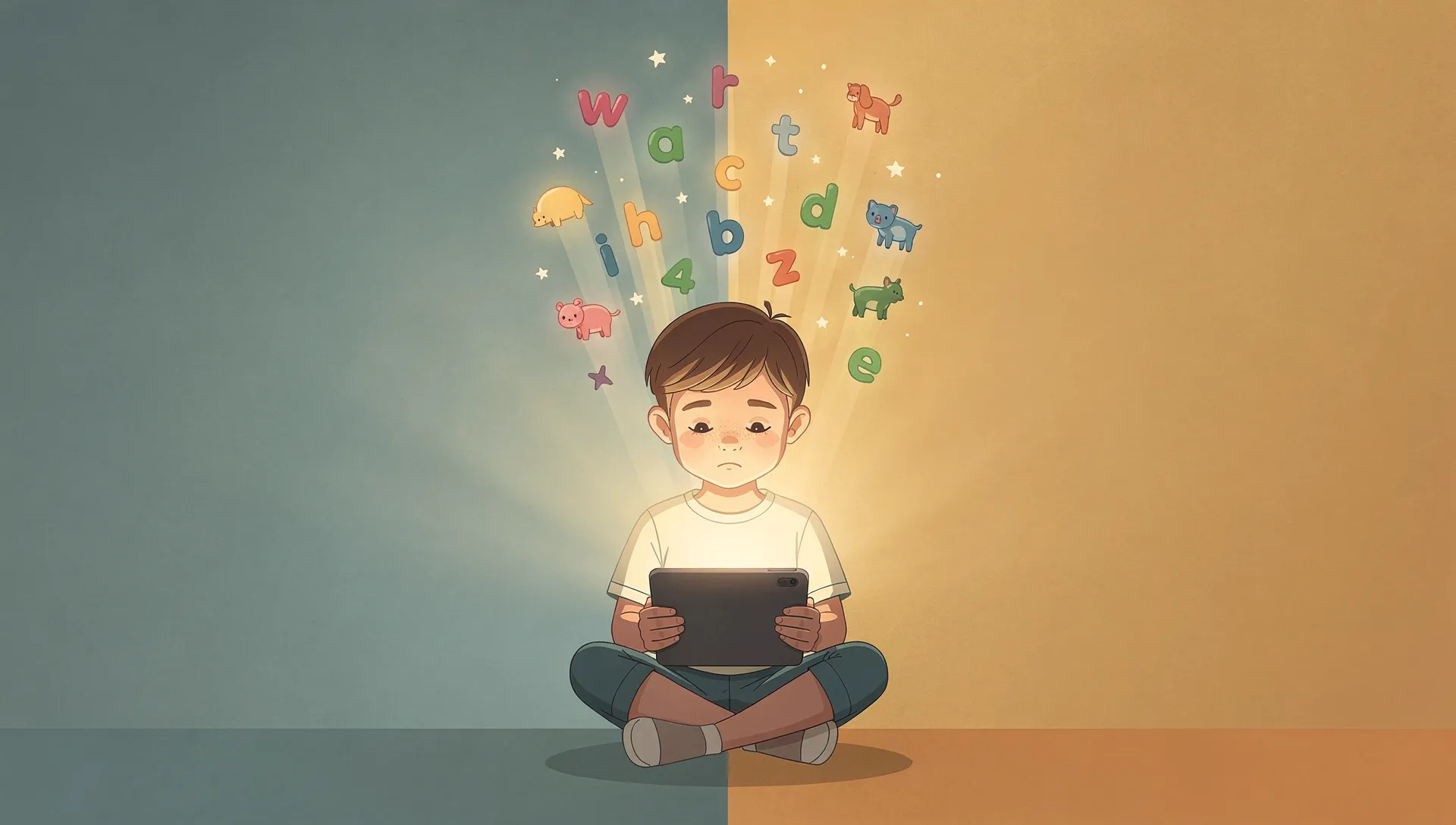
Screen Time & Language Learning: What 47 Studies Actually Say
74% of American parents feel guilty about their child's screen time. That number comes from a 2025 survey of 1,000 parents with kids aged 2 to 8. Another Pew Research study found that 86% of parents say managing screen time is a daily priority, with moms feeling significantly more judged than dads about how they handle it.
But here's the thing almost no headline tells you: the research doesn't say screen time is universally bad for language development. It says something far more specific and far more useful.
We read 47 studies, systematic reviews, and meta-analyses published between 2018 and 2025 so you don't have to. What follows is a parent-friendly breakdown of what the science actually shows, what it doesn't show, and what you can do with that information today.
The headlines vs. the reality
The typical headline reads something like: "Screen time delays language development in young children." That's technically true. But it's also dangerously incomplete.
A 2024 systematic review in Brain Sciences examined 18 studies and found that prolonged screen time in the first two years of life can negatively affect language development and communication skills. A separate scoping review analyzing 16 studies found that nine reported negative effects, five found no significant impact, and two actually reported positive effects.
Out of 16 studies, only slightly more than half found a negative link. The rest found either nothing or a benefit.
The relationship between screens and language isn't a straight line. It's a web of variables: what kind of content, how long the child watches, whether a parent is present, whether the child interacts with the screen or stares at it, and how old the child is.
Treating all screen time as one thing is like treating all food as one thing. A bowl of fruit and a bag of candy are both "food." No pediatrician would tell you they have the same effect on your child's health.
Passive vs. interactive: the distinction that changes everything
This is the single most important finding most parents never hear: not all screen time affects language development the same way.
A 2021 study published in Frontiers in Education found that time spent passively watching digital devices (television, streaming video) is negatively related to a child's ability to process verbal information. But interactive time spent with touchscreen technologies showed no significant negative effect on the development of phonological memory in preschool-aged children.
Passive watching hurts. Interactive engagement doesn't.
The International Congress of Infant Studies reported that each additional hour of passive video watching can lead to a reduction of six to eight words in a young child's vocabulary. Before the age of one, watching more than two hours of television per day can increase the risk of language delay by six times.
But interactive media tells a completely different story. Research published by ScienceDaily shows that younger toddlers may learn more from interactive digital media (video chats, touchscreen apps) than from television and videos alone. The key factor: does the screen require the child to respond, think, and participate? Or does it just ask them to sit and absorb?
A PMC study on interactive screens found that interactive and educational content, when paired with social interaction, actually promotes linguistic development. Passive content doesn't come close.
The "video deficit effect," and how interactivity overcomes it
Researchers have long documented what they call the "video deficit effect." A 2021 meta-analysis in Child Development covering 59 reports found that children ages 0 to 6 learn about half a standard deviation less from video than from the same information delivered in person.
But this deficit isn't inevitable. When screens include social contingency (the content responds to the child in real time), the deficit shrinks dramatically. Research from PMC shows that children can learn new facts equally well from interactive media as from face-to-face instruction, as long as the media is designed with contingent, responsive interaction.
By 24 months, children learn the meanings of new words equally well from live video interaction as from face-to-face interaction. But not from pre-recorded, non-interactive video.
Screens aren't the problem. Passivity is.
What the AAP actually recommends (age by age)
The AAP guidelines are frequently cited but rarely quoted in full. Here's what they actually say:
Under 18 months: Avoid screen use entirely, except for video chatting with family. Learning at this stage depends almost entirely on real-world, face-to-face interaction. Background television is also discouraged because it distracts babies and may interfere with language development.
18 to 24 months: Screen time should be limited to watching educational programming together with a caregiver. The "together" part isn't optional. Co-viewing at this age bridges the gap between screen content and real-world understanding.
Ages 2 to 5: Limit screen use to one hour per day of high-quality programs. Co-view with your child to help them understand what they're seeing and apply it to the world around them.
Ages 6 and up: Place consistent limits on the time spent using media. Make sure screen time doesn't replace adequate sleep, physical activity, and other behaviors essential to health.
The updated AAP guidance now stresses quality, context, and conversation over strict time limits. This is a meaningful shift. The AAP is acknowledging that what a child does on a screen matters more than how many minutes the screen is on.
The 5 criteria for "good" screen time
Not all apps that call themselves "educational" actually are. In fact, many bore kids within a week because they lack the variety needed to sustain engagement. A 2022 study in PMC applied the "Four Pillars of Learning" framework to children's apps and found that most scored low on educational value, with free apps scoring even lower than paid ones.
Here's a research-backed framework for evaluating whether screen time is genuinely beneficial for your child's language development:
1. Active participation, not passive consumption
The app should require your child to think, respond, and make decisions. Tapping a button to start the next video doesn't count. The child should be questioning, guessing, and evaluating. Research confirms that children benefit from actively engaging with media but don't learn from passively watching it.
2. Focused engagement without distraction
Good educational content keeps children focused on the learning task itself. Overwhelming sound effects, flashy animations, pop-up ads, and gimmicky reward systems pull attention away from learning. If an app feels more like a slot machine than a classroom, it's optimized for engagement metrics, not education.
3. Meaningful connection to the real world
The content should connect to things your child already knows and experiences. Words should be tied to objects, actions, and situations that exist outside the screen. An app that teaches the word "apple" while showing an apple, prompting the child to say it, and encouraging them to find one in the kitchen is doing meaningful work.
4. Social interaction built in
The best educational media creates opportunities for social exchange, either between the child and a caregiver or between the child and the app itself through responsive, contingent interaction. Apps that invite a parent to participate, or that respond dynamically to a child's input, support the kind of social learning that drives language acquisition.
5. Short, bounded sessions
Duration matters. The negative effects of screen time are dose-dependent. An app that naturally limits sessions to five to ten minutes and encourages the child to stop and do something else is working with the research, not against it.
We built Small Universe around all five of these criteria. Every lesson uses one of 17 interactive game types that require active participation: matching, memory, word building, drag-and-drop, drawing, and more. Sessions last 5 to 7 minutes. No passive videos, no ads, no infinite scroll. Try it free.
How to choose educational language apps that actually work
Beyond the five criteria above, here are practical questions to ask before downloading any language learning app for your child:
Does it require my child to produce language, or just hear it? Apps that ask children to say words, build sentences, or choose between options are more effective than apps that simply play audio. Expressive practice is where real acquisition happens.
Can my child use it without reading? For pre-readers (ages 3 to 5), the app should use audio instructions, visual cues, and intuitive design. If your 4-year-old can't figure out what to do without reading text, the app wasn't designed for them. See our guide to the best English apps for 3-4 year olds for options that get this right.
Does it adapt to my child's level? A 3-year-old and a 7-year-old shouldn't be doing the same activities. Look for apps that adjust difficulty, gate content by age, or offer leveled progression.
Is there variety in how content is presented? Children learn through repetition, but they disengage from monotony. Multiple game types teaching the same vocabulary from different angles produce stronger retention than a single format repeated endlessly.
Does it end? Surprisingly useful test. Good educational apps have natural stopping points. They complete a lesson, celebrate the achievement, and suggest the child come back later. Apps that never want your child to stop are optimized for screen time, not learning time.
Co-viewing: the strategy that doubles the learning
If there's one action you can take to transform your child's screen time from questionable to beneficial, it's this: watch with them.
Research from PMC shows that co-viewing supports toddlers' word learning from both contingent and non-contingent video. Children in co-viewing groups generated considerably more language than children who watched alone.
A study on two-year-olds found that toddlers who struggled to learn individual words from video clips succeeded when parents provided a simple scaffold, pointing out that real objects in the room corresponded with what was being labeled on the screen. That small act of connection between the screen world and the real world was enough to unlock the learning.
How you co-view matters as much as whether you do it at all. Research shows that the manner and number of words a parent speaks to a child while watching together is as important as what's being watched.
Practical co-viewing tips
Name what you see. When a word appears on screen, say it out loud. Point to the object. Use it in a sentence. "Look, a rocket! Can you say rocket? What color is the rocket?"
Connect to real life. After a lesson about animals, go find a picture book about animals. After a lesson about colors, go on a color hunt around the house. The bridge between screen and world is where the deepest learning happens.
Ask open questions. Instead of "Did you like that?" try "What did the astronaut find?" or "Which word was your favorite?" Open-ended questions prompt your child to retrieve and use the language they just encountered.
Celebrate effort, not speed. When your child gets a word right, acknowledge it. When they get it wrong, help them try again without pressure. The emotional safety of the learning environment matters more than the app's scoring system.
Make it a routine, not a reward. Five minutes of learning English together after breakfast is more effective than 30 minutes of unsupervised screen time used as a reward for good behavior. Routine creates expectation. Expectation creates readiness to learn. If you need a practical framework, we've put together a 15-minute daily English routine that builds on this principle.
Small Universe is designed for co-play. Every game type works well with a parent sitting alongside, and many activities naturally prompt conversation between you and your child. The space exploration theme gives you a shared story to talk about beyond the screen. Explore the planets together.
The reading connection
Here's a finding that deserves more attention than it gets. A 2024 study of over 31,000 children in BMC Public Health found that reading frequently to a child partly buffers the negative effects of high mobile device screen time on language comprehension.
Parents who read to their children regularly can offset some of the risks associated with screen time. This doesn't mean reading cancels out excessive passive screen use. But a household where books and screens coexist, where a child uses an educational app for a few minutes and then reads a story with a parent, is doing something fundamentally different from a household where the screen replaces the book.
The two aren't in competition. They're complementary.
What this means for you
Let's bring this down to something practical. Based on 47 studies, here's what the research actually supports:
The age your child starts also shapes the approach.
If your child is under 18 months, keep screens to video calls with family. Focus on talking, reading, singing, and face-to-face interaction. This isn't the time for apps, no matter how good they are.
If your child is 18 months to 2 years, you can begin introducing short, interactive, educational content, but only together. Sit with your child. Talk about what you see. Connect the screen content to real objects and experiences.
If your child is 2 to 5, one hour per day of high-quality, interactive educational content is within AAP guidelines. Prioritize apps that require active participation over passive video. Co-view when you can – our tips on how to teach English to preschoolers cover this in detail. Read together every day.
If your child is 5 to 10, the research supports interactive educational screen time as a complement to other learning. At this age, children can benefit from game-based language practice – see our guide to the best English apps for 5-7 year olds – especially when it includes variety, progression, and natural stopping points. Understanding how children's brains learn language helps explain why interactive formats work so well during this window.
Across all ages, the quality of what your child does on a screen matters far more than the number of minutes. Passive consumption of videos is consistently linked to poorer language outcomes. Interactive, educational, age-appropriate content with social engagement built in is not. Our roundup of the best English games for kids can help you find options that meet these criteria.
The bottom line
The guilt that 74% of parents feel about screen time is understandable. The headlines are alarming, the research is dense, and nobody has time to read 47 studies while making dinner.
But the research doesn't say "screens are bad for your child's language development." It says passive, unsupervised, prolonged screen exposure can be harmful, especially in the first two years.
It also says that interactive educational content, co-viewed with a caring adult, bounded in duration, and connected to real-world experience, can support language development rather than hinder it.
You're not a bad parent for handing your child a screen. You're a thoughtful parent for asking what they're doing on it.
Small Universe is a space-themed English learning app for kids ages 3 to 10, featuring 17 interactive game types across 7 planets of progressive difficulty. Every lesson requires active participation, lasts 5 to 7 minutes, and is designed for the kind of screen time the research actually supports. Start your child's journey for free.
References
- Skalicka, V. et al. (2024). "The Relationship between Language and Technology: How Screen Time Affects Language Development in Early Life – A Systematic Review." Brain Sciences, 14(1), 27. PMC
- Siddique, A. et al. (2023). "Is the screen time duration affecting children's language development? A scoping review." Early Childhood Education Journal. ScienceDirect
- Madigan, S. et al. (2020). "Associations Between Screen Use and Child Language Skills: A Systematic Review and Meta-analysis." JAMA Pediatrics, 174(7), 665-675. JAMA Network
- Strouse, G.A. & Samson, J.E. (2021). "Learning From Video: A Meta-Analysis of the Video Deficit in Children Ages 0 to 6 Years." Child Development, 92(1). Wiley
- Silva Junior, R.A. et al. (2025). "Impact of the Use of Interactive Screens on Language Development in Children up to 6 Years of Age: A Systematic Review." Child: Care, Health and Development. PMC
- Herodotou, C. (2022). "How educational are 'educational' apps for young children? App store content analysis using the Four Pillars of Learning framework." Journal of Computer Assisted Learning. PMC
- Troseth, G.L. et al. (2018). "Co-Viewing Supports Toddlers' Word Learning from Contingent and Non-Contingent Video." Journal of Experimental Child Psychology, 166. PMC
- Haakansson, E. et al. (2024). "Mobile device screen time is associated with poorer language development among toddlers: results from a large-scale survey." BMC Public Health. Springer
- Huber, B. et al. (2018). "Young toddlers may learn more from interactive than noninteractive media." Computers in Human Behavior. ScienceDaily
- Kostyrka-Allchorne, K. et al. (2021). "Short- and Long-Term Effects of Passive and Active Screen Time on Young Children's Phonological Memory." Frontiers in Education. Frontiers
- American Academy of Pediatrics. "Screen Time Guidelines." AAP
- Pew Research Center (2025). "How Parents Approach Their Kids' Screen Time." Pew Research
Frequently asked questions
Is screen time bad for language development in children?
Passive screen time — watching videos without interaction — is associated with slower vocabulary growth in young children. But interactive screen time, where the child must respond, choose, or produce language, is functionally different. Research consistently shows it can support language development when well-designed and age-appropriate.
How much screen time is acceptable for language learning?
The American Academy of Pediatrics recommends a maximum of one hour per day for children ages 2–5. For language learning, 10–20 minutes of high-quality interactive practice is more effective than longer passive sessions. Quality and interactivity matter more than raw duration.
Do language learning apps actually work for young children?
Yes, when designed for active participation. Studies show that apps requiring a child to touch, choose, drag, or speak — what researchers call "contingent response" — produce vocabulary gains comparable to live instruction for familiar topics. Apps that simply play audio or video without requiring child input are far less effective.
Is educational screen time the same as regular screen time?
Not according to the research. Interactive educational content — where the child must participate to advance — is categorically different from passive viewing. The AAP itself distinguishes between "quality programming" and background TV. Context, content, and interaction design all determine whether screen time helps or hinders language development.
Try Small Universe free
17 game types. 7 planets. Zero ads. Your child learns English through space exploration.
Play free — no account needed